

Opening a Self-Service Laundry: Layout, Payment and Workflow
Opening a self-service laundry involves far more than choosing machines. Customer routes, payment options, clear instructions, cleaning, maintenance and safe operation all matter. The number of stations should reflect expected peaks and floor space. This guide explains the operating choices behind an unattended laundry, not a ranking of products.
What machines do you really need in a self-service laundromat?
A self-service laundromat requires industrial washers, industrial dryers, payment systems, functional furnishings, and, when the model requires it, digital solutions for remote control, vending, or additional services. The priority is to build a balanced fleet: large enough to handle peaks, but not oversized for the area, the number of customers, and the expected volume.
Laundry machines shouldn't be evaluated solely on capacity and price. It's important to consider cycle duration, user-friendly interface, the availability of dedicated programs, water and energy consumption, ease of maintenance, and the supplier's support. In a self-service business, every minute of downtime counts: a reliable machine, even if more expensive initially, can prove more cost-effective over time.
How do you assess the service before equipment prices?
When it comes to the best self-service laundry equipment: focus on value for money, the key isn't finding the cheapest option, but rather the one that delivers value over the life of the facility. A cheap machine may seem attractive at first, but it can become expensive if it consumes too much power, requires frequent repairs, or offers a complicated user experience.
To evaluate the quality-price ratio, it is worth looking at these criteria:
This approach helps compare laundry equipment not as individual products, but as profitability tools. A well-designed laundry doesn't depend on a single high-performance machine: it works because the entire system works together.
Industrial washing machines and industrial dryers as a focus of investment
Industrial washing machines are the operational heart of the business. They must handle a variety of loads, withstand repeated use, and offer cycles that are easy to understand even for first-time users. In a self-service laundromat, simplicity is a form of efficiency: fewer customer questions mean fewer service calls and fewer user errors.
Commercial dryers have an equally significant impact. Slow or irregular drying can lead to queues, dissatisfaction, and high energy consumption. Therefore, it's helpful to choose models with good air distribution, easy-to-clean filters, and programs suitable for different fabrics. Capacity should also be matched to that of the washing machines: if drying becomes the bottleneck, the entire laundry flow in the room slows down.
A balanced assortment can include machines of different capacities. Smaller units serve everyday laundry needs, while larger ones cater to needs such as duvets, blankets, and linens for B&Bs, small hospitality businesses, or customers with bulky loads.
Technology, automation and services that increase value
Modern laundry equipment goes beyond washing and drying. More and more investors are looking for systems that improve the customer experience and make management less dependent on the physical presence of staff. Automation can include payments, notifications, cycle control, smart lockers, lockers for pickup and delivery, or automatic product dispensing.
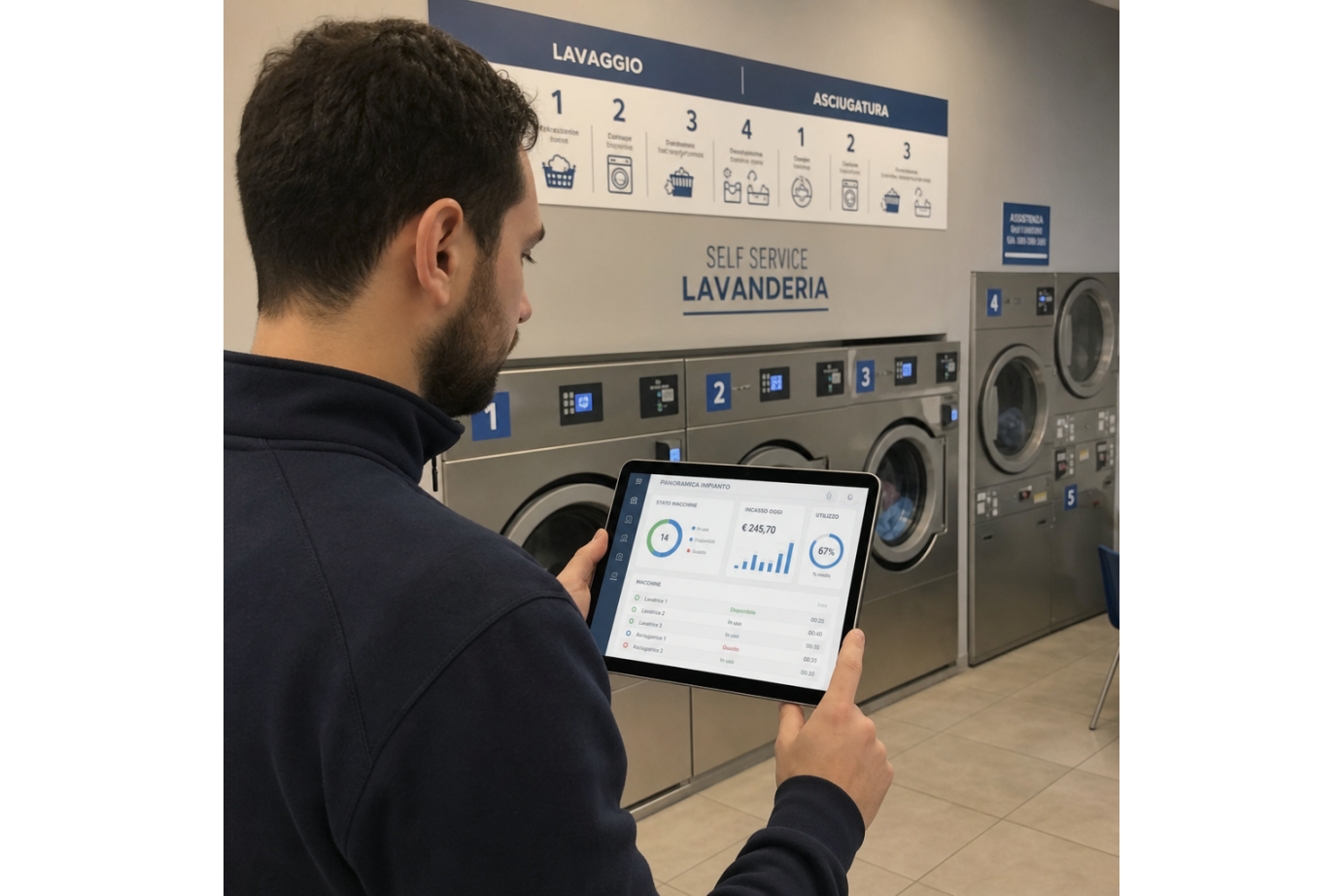
These solutions are particularly useful when a laundromat wants to offer 24/7 services or serve a variety of audiences. For example, a smart locker system can allow for automated laundry drop-off and pick-up. Management software can help monitor revenue, machine usage, anomalies, and demand spikes. Digital payments reduce cash handling and simplify revenue tracking.
Additional services can also differentiate the business:
- Sanitization programs , useful for customers sensitive to deep cleaning.
- Dedicated laundry for pet items , if the premises and operating regulations allow it.
- Wet cleaning for delicate garments , when you want to expand your offering beyond standard laundry.
- Automatic dispensers for detergents and accessories , to increase convenience and generate additional revenue.
- Clear notifications or displays , to guide the user and reduce confusion during service.
How can costs and revenue be evaluated without arbitrary assumptions?
The return on investment is estimated by comparing initial cost, operating costs, expected usage, cycle prices, maintenance, and the ability to generate additional sales. It's not enough to calculate how many washes are needed to "pay for" a machine: you need to evaluate how much that machine impacts consumption, time, customer satisfaction, and service continuity.
A practical assessment should include:
The most robust model is one that remains sustainable even with cautious initial demand. If the plan only works with constantly full machines and perfect margins, it's too fragile. It's better to plan for gradual growth, with modular equipment and the ability to add services when the local market allows.
Practical choices before buying
Before ordering laundry equipment, it's helpful to turn the idea into a practical checklist. This step prevents impulse purchases and helps you communicate more accurately with suppliers.
Essential checklist:
This phase is also the right time to think about the layout. Simple paths, convenient folding areas, clear signage, and clean spaces improve the perception of service. A laundromat may have excellent machines, but if the customer doesn't understand where to go, how to pay, or which cycle to choose, the experience loses its value.
Investing with a long-term logic
The most suitable laundry equipment combines performance, reliability, and ease of management. It must not only work on opening day, but also withstand years of use, service upgrades, and changes in local demand.
Before finalizing a layout, prepare a floor plan, estimate demand by time of day and define the payment setup. Washer compatibility and token or alternative payment integrations must be verified for the specific project.
Before opening to customers, test the payment and operating journey described in the self-service payment testing guide.