

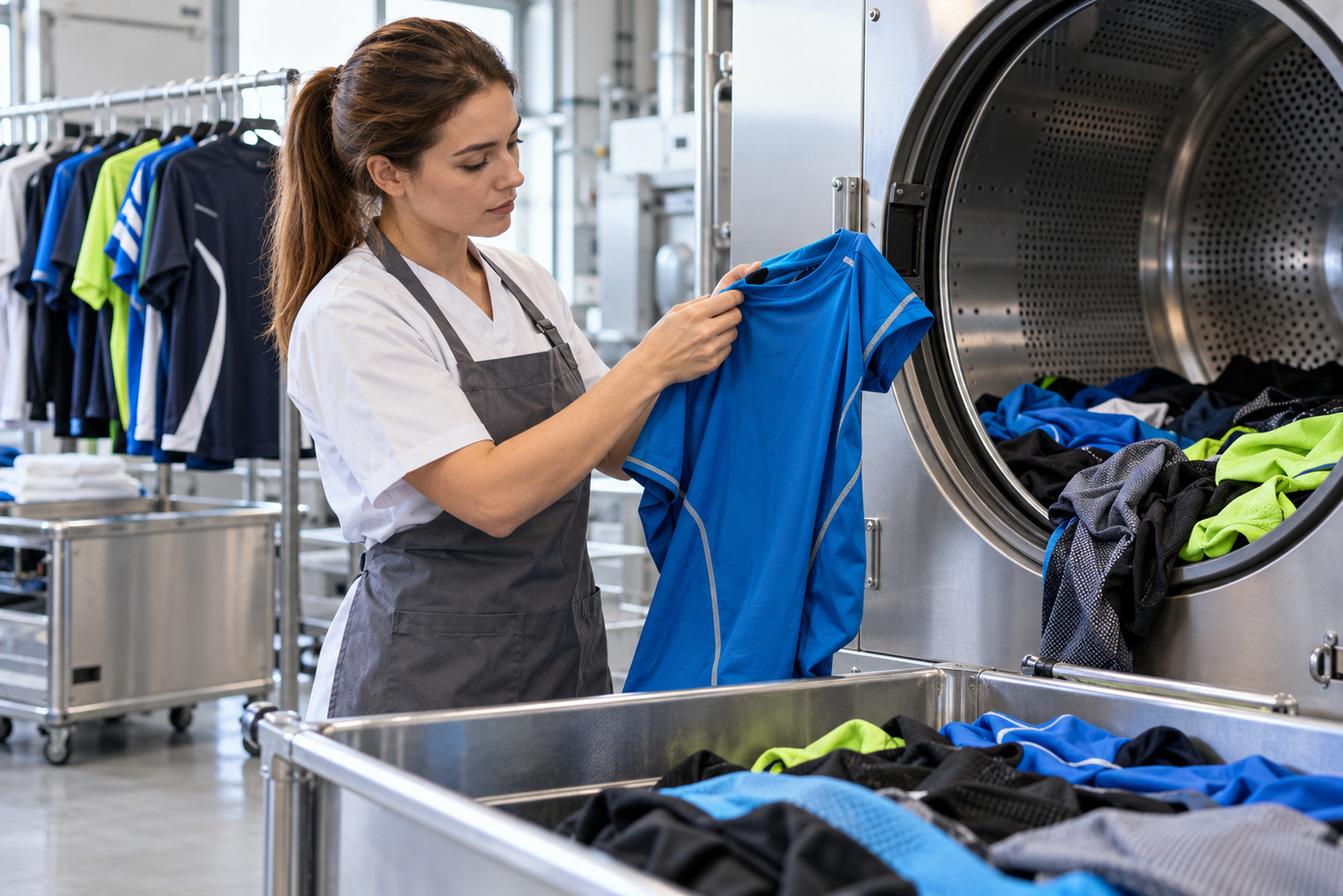
Drying Performance Sportswear: Avoiding Fabric Damage
Sports shirts, technical shorts and stretch garments do not behave like cotton towels. Synthetic fibres, prints, membranes and elastic inserts require a compatibility check before selecting a drying programme. A garment may feel dry yet have lost stretch or changed shape, while a shortened cycle may leave moisture in seams or pockets. This guide is for gyms, sports clubs and commercial laundries that process repeated batches without allowing pressure for speed to jeopardise garment care.
Read the care label before choosing a programme
Do not infer a safe drying temperature merely because an item is described as sportswear. Similar-looking garments may contain different fibres and carry different tumble-drying restrictions. If the label prohibits machine drying, do not attempt to bypass it with a shorter cycle. Ask customers or suppliers for care specifications on unusual items. Group only compatible garments and maintain a separate route for those needing another process.
Protect elastics, membranes and decoration
Elastic bands, heat-bonded logos, applied prints and waterproof layers may respond differently from the base fabric. Inspect seams and decorations before drying and record pre-existing damage. Do not combine lightweight garments with heavy textiles requiring much longer treatment. End-of-cycle checks should include garment shape and printed details, not only whether the fabric feels dry to the touch.
Why batch volume matters as much as mass
A drum packed beyond the model's guidance cannot tumble textiles effectively. With lightweight synthetic clothing, volume may become the limitation before weight. Follow manufacturer instructions for load and programme, checking free movement and batch distribution. Overloading does not merely extend processing time: it may leave some areas damp while other garments receive unnecessary exposure.
An operating procedure for technical sportswear batches
A company processing uniforms for several clubs should preserve both garment compatibility and customer identity. Before work, document unfamiliar care labels, badges and delicate prints. Create a shared load only when the instructions allow it. Colour alone is not a sufficient criterion: elastic panels and membranes can behave differently from surrounding fabric. Inspect stitched accessories and existing damage before processing to prevent disputes that are difficult to resolve later.
A useful job sheet checks five conditions: care instructions read, batch compatibility confirmed, load mass and volume appropriate, programme authorised and representative final inspection completed. If any item fails an earlier check, select a different process or consult the textile owner. Staff should not assume that the availability of a setting on a control panel means every garment is suitable for it. Equipment capability and textile care rules are distinct.
In a hypothetical initial test, compare similar batches of sports tops without altering several variables at once. Record twisting, shape change and local damp areas. If seams remain damp while the main panels feel dry, review textile construction and batch preparation first. A simple quality report containing representative photographs is much more useful than a broad claim that all sports garments can be dried in the same way.
A quality check that protects the customer
At the end, inspect a representative sample for odour, moisture in seams, shape changes and elastic-component integrity. Compare with a reference item where one exists. Isolate suspect batches before dispatch; the correction should not automatically be to raise temperature or extend time. Investigate loading, washing, extraction and permitted airflow checks using the site's approved procedures.
A simple sheet for controlled comparison
Hypothetical test: prepare two comparable loads of the same garment using only programmes permitted by the care labels and machine instructions. Record duration, seam observations and inspection outcome. Do not change multiple conditions at once. The test supports a repeatable procedure for that textile; it does not establish a universal energy-saving or garment-life claim.
When to compare professional dryers
Where technical sportswear forms a substantial workload, document garment mix, volume, restrictions, batches per shift and required checks. Compare professional tumble dryers against those requirements without assuming every model has every optional control. Also review professional washers and extraction performance, which determines how much moisture remains for the drying stage.
Sports textile release checks
| Data point | Purpose |
|---|---|
| Care label | permit the method |
| Fabric mix | batch compatibility |
| Trims | avoid damage |
| Final check | evidence of quality |
Comparing garments and outcomes
Does low heat always make tumble drying safe?
No. A care-label prohibition still applies regardless of the selected heat level.
Can I dry sportswear with towels?
Only if instructions are compatible; required mass handling and time may differ markedly.
A practical sample check can compare two garments of the same construction before a procedure is applied to a wider batch. Note whether labels are still readable, whether elastic zones have changed shape and whether decorated surfaces show curling or separation. These observations are more useful than a claim that a cycle is 'gentle' without an agreed acceptance criterion. A garment that cannot be tumble dried according to its care instructions must not be put into an experimental dryer programme to meet a production target. Keep customer care instructions and approved site procedures as the governing references.
Technical sportswear requires respect for garment limits and checks of retained properties. Running every jersey through the same setting is an unreliable shortcut. Care instructions, compatible loads and final-product checks should guide the laundry procedure.
To avoid mixing sportswear with incompatible loads, consult the guidance on mixed and delicate loads.