

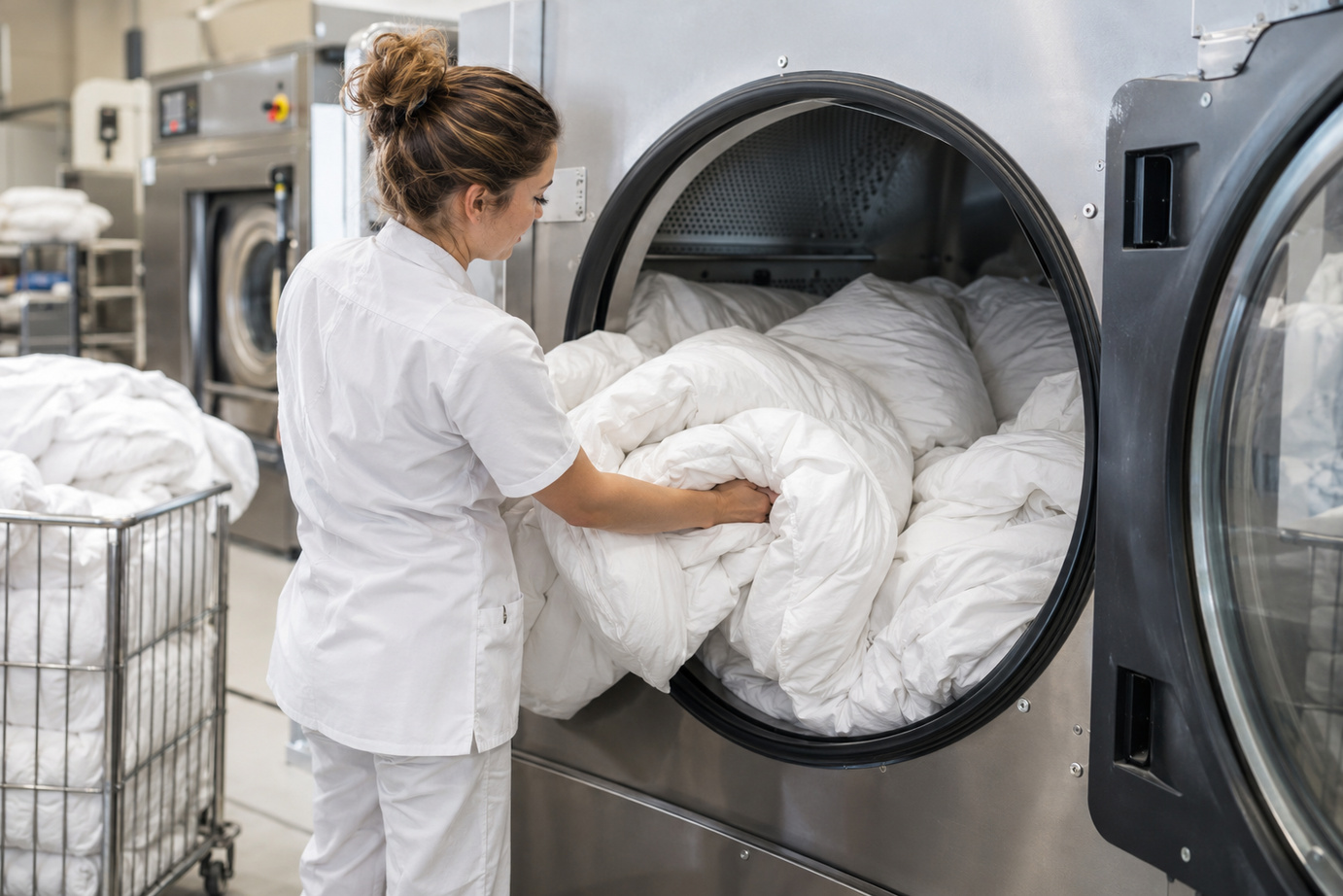
Duvets and Bulky Linen: Drying Checks Before Loading
Duvets, quilts and other bulky items create different challenges from flat linen. They can occupy most of a drum without weighing very much, retain moisture in interior areas and contain fills or shells unsuitable for particular drying methods. Safe decisions begin with the care label and supplier instructions, not external size alone. This guide provides a pre- and post-cycle checklist for laundries and hospitality services receiving varied bulky items.
Check the cover, filling and care label
Not all duvets are alike. Down, synthetic filling, batting and composite construction can carry different care requirements. Identify the stated materials, inspect seams and existing damage and confirm tumble drying is permitted. If instructions are missing or contradictory, obtain clarification from the client or textile supplier. Incompatible treatment may distort the shape, clump filling or damage the outer shell.
Mass and volume are different limits
A bulky article may prevent proper tumbling long before the dry weight approaches rated capacity. Do not compress a duvet into the drum or use a programme unless manufacturer guidance permits the item. Air movement through the filling also matters. For multiple-item loads, evaluate each configuration against equipment instructions rather than treating the maximum rated kilograms as a target.
The transition from washing to drying
Condition after washing determines part of the drying workload. Confirm that extraction was suitable for the textile and machine, that filling shows no obvious damage and that transport protects the item from contamination. Do not attempt improvised corrections while equipment is operating. Preparation mistakes may only become apparent at the end when some areas are dry but internal sections remain damp.
A receiving sheet for bulky textile items
Provide an intake record with item ID, approximate dimensions, declared fill, any treatment restrictions and visible prior defects. If the label is absent, record this and request appropriate care information before proceeding. Customers should understand that a very bulky item can be unsuitable for a machine even if its dry weight is below the nameplate capacity. Do not promise results until suitability and freedom of movement can be established.
During final inspection, pay attention to thicker seams, corners, central fill areas and sections that tend to fold onto themselves. Use only the checks permitted by the service procedure and avoid damaging the item. If the article must wait, preserve its identification and required storage conditions. A surface that appears dry is not enough if the article has not passed the agreed pre-packing inspection.
Where many duvets are processed, retain a record of sizes, construction and outcomes to determine whether different equipment would address the real constraint. Some products will still need an alternative process. When comparing machines ask about working space, loading access and supported programmes, not only nominal kilograms. In some circumstances the correct professional decision is to decline an incompatible treatment.
Check the interior rather than only the surface
The shell can appear dry while seams or filling retain moisture. Use an approved quality-check method that examines representative areas and the thickest sections without damaging the material. Record findings and any limitations of the test. If an article fails inspection, keep it apart and consider further processing only where textile and equipment instructions allow it. Do not pack items of uncertain condition.
Prevent disputes with an intake form
At intake, record dimensions, declared materials, missing labels, pre-existing marks and visible damage. Customer-agreed photographs can be valuable for expensive items. Explain early if the requested treatment is unsuitable or an alternative service is required. The form is not a device for avoiding responsibility; it records what was accepted and which procedure was agreed.
Choose dryers around the actual item mix
Before comparing professional dryers, list the bulky products handled most often, with their sizes, dry weights and frequency. Larger operations may consider industrial dryers, while checking actual drum suitability, programmes and loading access. A larger machine may create useful space; it does not automatically make every duvet compatible with machine drying.
Bulky-item inspection data
| Data point | Purpose |
|---|---|
| Care label | drying suitability |
| Volume | drum movement |
| Filling | inspect inner areas |
| Final condition | product acceptance |
When a programme is unsuitable
Can a light duvet still overload the usable drum space?
Yes. Volume and freedom of movement matter alongside weight.
Is touching the outside enough to confirm dryness?
No. The inspection method must address relevant internal areas.
For products with multiple layers or fillings, inspect the result in the places most likely to retain moisture rather than judging only the outer surface. Use a method suitable for the item and follow its care label. A large item may fill much of the drum even when its dry weight is within a nominal capacity figure; lack of movement can affect the outcome. Discuss uncertain compatibility with the customer or supplier instead of promising that every duvet can be processed. Record any item-specific restrictions so the next operator does not repeat an unsuitable trial.
Bulky articles require more than a permissible care symbol: drum movement, input condition and final inspection matter. When suitability cannot be demonstrated, requesting advice or offering an alternative treatment is more professional than promising an unverified outcome.
To compare outcomes for bulky batches, use the method in the dryer-programme review method.