

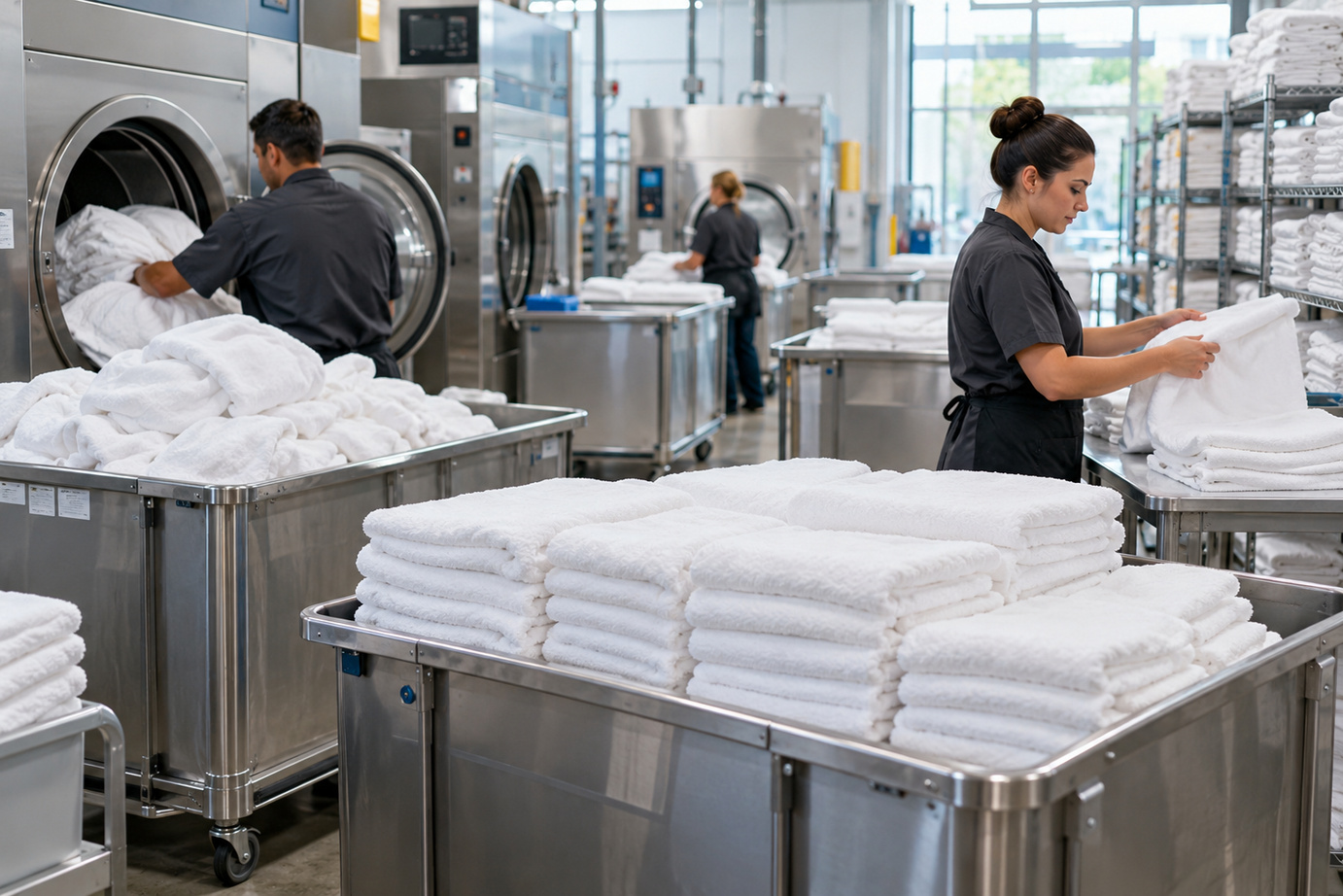
Gym and Spa Laundry: Organising the Towel Turnover
At a gym or spa, towels may return in waves: when fitness classes finish, changing rooms empty or treatment cabins close for the day. The challenge is not just washing them. Clean towels must be available exactly when customers need them. Damp storage, disorganised collection and long waiting times can cause shortages even when the laundry owns enough machines. A useful plan therefore begins with peak-hour demand and distinguishes towels currently in use, towels awaiting processing and towels genuinely ready to hand out.
Map demand by time of day
Start by counting towels issued during representative periods: early morning, lunchtime, after popular classes and in the evening. Item counts are more useful to reception and changing-room staff than kilograms guessed by eye. For planning washing cycles, the pieces should later be converted into actual weight using a measured sample for each towel type.
A gym issuing small workout towels and a spa using large bath sheets have different load profiles. Keep their figures separate to prevent incompatible batches from being combined. Events and busy classes may produce a short, intense peak; monthly averages can hide the two-hour period that actually creates service failures. Capture several weekdays and weekends before making conclusions.
Give damp collection its own operating rules
Return points should be easy for customers to recognise and easy for staff to empty promptly. Leaving large volumes of damp towels compressed in unsuitable containers for extended periods makes controlled handling more difficult. Collection methods, permitted holding times and any special segregation requirements should be set by the responsible operator under applicable site hygiene procedures.
Do not assume one washing programme can cure every odour problem. When issues recur, reconstruct the time the batch spent waiting, container condition, textile composition and processing result. That evidence helps distinguish a collection problem from one that developed during laundering. Cleaning the containers is part of the same workflow, not an optional task delegated vaguely to the washer operator.
Calculate what the customer-facing area needs
Required additional clean towels = expected issues during the period + chosen contingency − clean pieces already available. This helps plan replenishment; it is not a formula for machine sizing. For illustration, assume a gym expects 90 towel issues in the next two hours, has 62 clean towels available and chooses a reserve of 12. The target is 102 pieces, so 40 more must be delivered to the distribution point.
| Time period | Illustrative towel demand | Key operational check |
| 07:00–10:00 | 65 | Pre-class cupboard supplies |
| 10:00–14:00 | 30 | Midday replenishment |
| 14:00–18:00 | 45 | Spa-return collection |
| 18:00–21:00 | 90 | Evening peak coverage |
These are invented planning values, not observations from a KENLE installation. An actual schedule needs local attendance and towel-issue records across several ordinary and busy days. A single popular class can materially move the peak from one weekday to another.
Measure return time, not only washer-cycle time
A towel must pass through collection, weighing, washing, unloading, transfer, drying, inspection and folding before it becomes available again. Planning solely from the duration displayed on a washer panel can produce a misleading promise to the front desk. Time several representative batches from bag collection to the moment folded clean pieces reach the cupboard.
When evaluating professional washing machines, explain how many separate loads are created and when their output is required. The professional tumble dryer range also matters: washing capacity does not create ready-to-use stock if wet loads wait for drying. Rated kilograms on two different types of machine should never be treated as proof that the whole process is balanced regardless of fabric or incoming moisture.
Run a shift-long trial
A simple trial follows one complete operating day and records four times for each batch: collection complete, wash start, dry start and clean-towel return. Note why each delay occurred. Was a trolley unavailable? Did staff wait for more linen to make a reasonable batch? Was a machine out of service? At the end of the shift, compare those waits with the periods when reception or changing rooms had no usable clean stock. This reveals whether the issue is a predictable demand peak or a preventable handling delay.
- Give each customer-facing towel station a named replenishment owner.
- Count clean pieces before and after busy periods.
- Separate textile types requiring different treatment.
- Record rejected or damaged towels instead of returning them to circulation.
- Agree a fallback plan for unexpected equipment delays.
Sometimes redistribution beats more machinery
When one cupboard is empty while another is full, the first solution is better distribution. When towels wait unnecessarily before washing, review collection frequency, priorities and batch formation. If several machines run fully but queues consistently remain, then a capacity review is justified. The most useful investment is the one that improves measurable towel availability, protects fabric condition and gives the team a repeatable routine without improvisation after every class.
For the handover from laundry to hotel drying operations, explore the hotel drying-shift workflow. For in-house washing of smaller towel batches, assess the 10–15 kg industrial washer range only after checking load weights and shifts.