

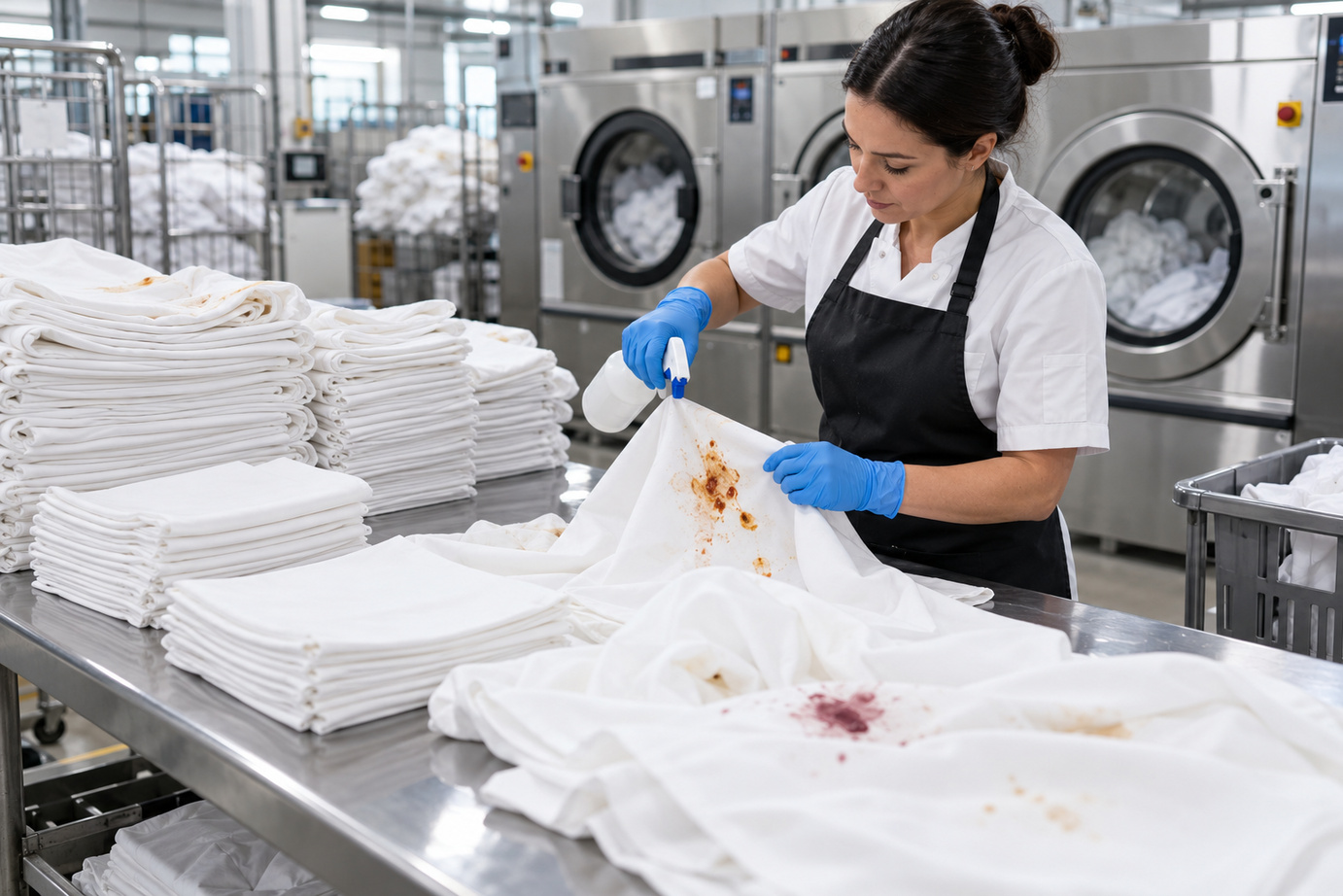
Restaurant Table Linen: Managing Stains Before Washing
A tablecloth that leaves the washer with a visible sauce stain does not automatically prove that the programme was too weak. The problem may have begun many hours earlier, when staff cleared tables, mixed textiles and failed to identify the type of soil. Restaurant and catering linen commonly contains combinations of oils, drinks, coloured foods and dried-on residues. A repeatable treatment process starts with collection and classification, not with indiscriminately raising the temperature or detergent dose.
Follow the cloth from table to collection
When service ends, staff should avoid wrapping cutlery and food waste into linen. Remove large debris using the venue's approved method before collection rather than rubbing a stain until it spreads. Used items should travel to a dedicated container. Fabrics left in warm, damp conditions for an extended period may behave differently when the laundry eventually starts.
A catering business collected at the end of an event has a different timeline from a restaurant with in-house laundry. Track the time of removal from tables and the start of treatment for a small sample of batches. If staining outcomes worsen on late-collection days, changing collection logistics may be more productive than selecting a new washer programme.
Use stain categories without pretending to know the chemistry
Appearance is not a definitive chemical diagnosis. Nevertheless, a small set of operational categories can prevent random treatment. Oil and cooking fat behave differently from pigmented drinks; an adhered, dried residue calls for different assessment from a fresh splash. Composition matters too. Cotton, polyester blends and specialist easy-care finishes may not respond to identical chemicals or mechanical action.
| Observation | Possible issue to investigate | Conservative next step |
| Greasy mark | Cooking oil or fat | Assess permitted pretreatment |
| Strong-coloured spot | Drink or pigmented food | Check fabric and chemical compatibility |
| Hardened patch | Dried-on residue | Hold for review before processing |
| Widening halo | Improper manual rubbing | Review collection and spot handling |
These are clues for investigation, not chemical identifications. Treatment must be compatible with fabric labels, chemical supplier instructions and local procedures. With valuable or delicate linen, stopping an uncontrolled treatment is often preferable to risking permanent damage.
A hotter cycle is not always a stronger solution
When a stain remains after washing, staff may instinctively choose a hotter cycle. That shortcut can be counterproductive: some soils become more difficult to address after unsuitable heat exposure, and certain textiles can suffer colour or dimensional changes. Incompatible chemicals can also produce unexpected outcomes. No single temperature suits all table linen. Follow textile guidance and agree a treatment approach with the laundry chemical supplier.
If the aim is to find the cause, change only one meaningful variable at a time in comparable batches. Record fabric type, source, collection time, approved pretreatment and programme. Changing chemical, temperature and holding time all at once prevents a useful conclusion, even if the next load happens to look better.
Match machinery to compatible batches
Process design depends on the amount and variety of table linen. A service handling white napkins, coloured cloths and specialist pieces may need several segregated cycles instead of one mixed load. When comparing industrial washing machines, ask how many compatible batches arrive in each shift, not only how much the drum can hold. Good separation both protects quality and makes the investigation of defects easier.
Machinery cannot guarantee the removal of every stain. Collection practices, wash chemistry, fabric condition and loading need to work together. A smaller catering operation may want to compare professional washers against actual shift volumes, avoiding oversized equipment or workloads that cannot realistically be completed before delivery.
Calculate rework as its own operational cost
For two representative weeks, keep a simple record: batch, outlet or client, number of items, visible incoming defects, pieces returned with faults and the response taken. There is no need to catalogue every tiny spot. The aim is to identify repeated patterns and their origins. If the same dining room consistently creates more difficult linen than others, staff training, products or collection practices may be contributing factors.
- Hold items requiring assessment outside the normal batch.
- Count pieces requiring rework, not only additional cycles.
- Record irreversible damage separately from temporary defects.
- Distinguish marks observed on arrival from faults first noticed after washing.
- Review the evidence with catering, laundry operations and chemical suppliers.
A basic rework rate is items returned for reprocessing ÷ items inspected × 100. For illustration, 12 pieces needing another treatment out of 240 checked equal 5%. This describes the selected sample only; it is not a target rate or a guarantee that all reprocessed items can be saved.
Make the next change evidence-led
When problems concentrate in old stains, focus first on collection and holding times. When issues cluster around one fabric, investigate compatibility and sorting. If defects suddenly affect almost every batch after a procedural change, compare the before and after records and request expert review where appropriate. An accurate log prevents every failed tablecloth from prompting an improvised new detergent recipe. The objective is not a promise of perfect cleaning in every circumstance, but a process whose results can be checked and steadily improved.
To organise table-linen loads after pretreatment, read the textile sorting procedure.