

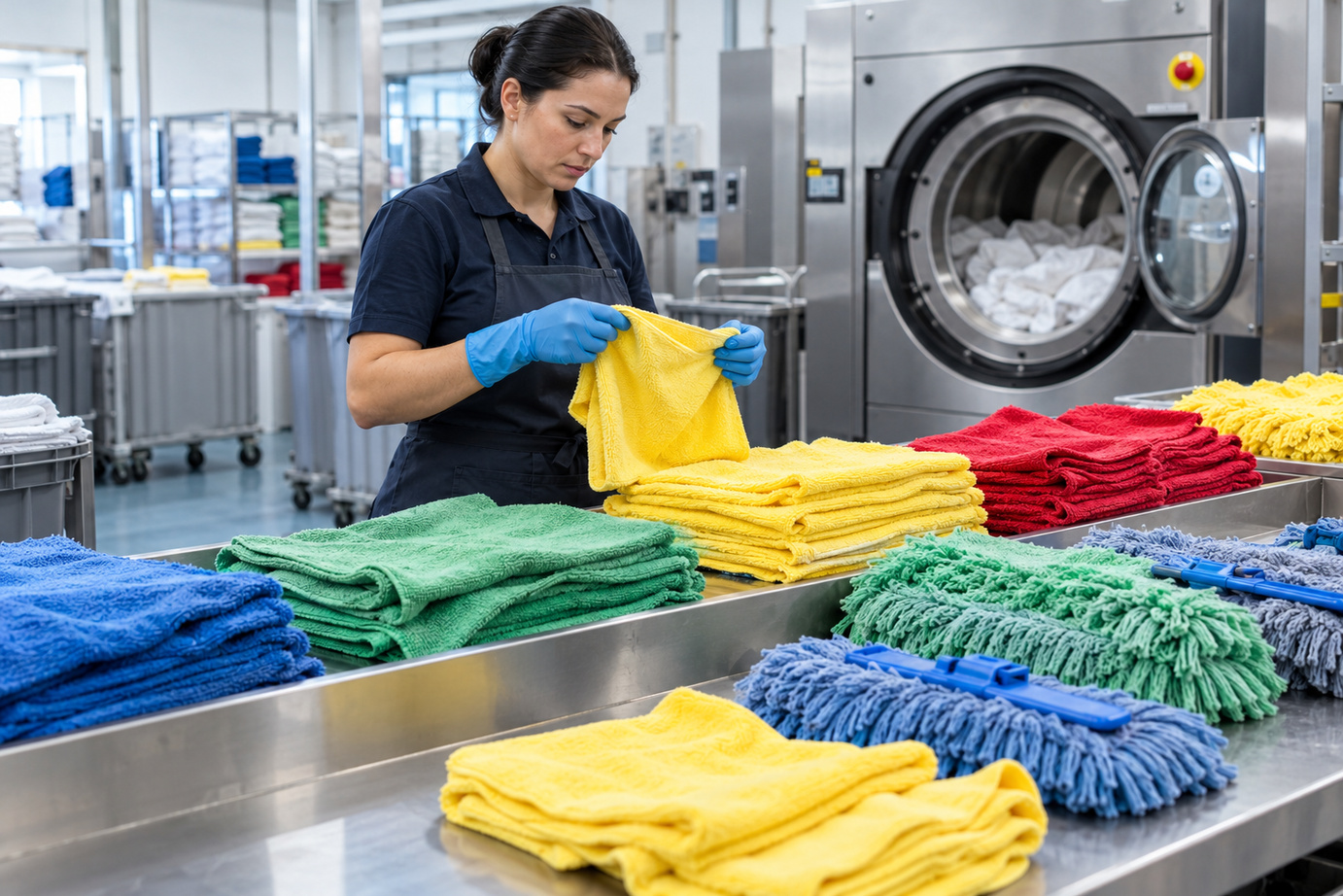
Microfibre Cloths: Washing Protocol for Cleaning Contractors
Microfibre cloths used by professional cleaning contractors are not ordinary rags that can be combined in any laundry batch. Depending on the site, they may collect dust, grease, chemical residues and contamination of very different kinds. An unsuitable laundering process can affect their cleaning performance and may move dirt from one working area to another. The correct process begins with the cloth's purpose, its manufacturer's care guidance and the customer's site requirements, rather than with a temperature chosen out of habit. The following method helps build a traceable process.
Sort by use and origin before filling a washer
A colour-coding system can distinguish washroom cloths from those used in offices or on food-contact surfaces. It works only when staff, collection bags and storage containers use the same scheme. Before emptying a bag, establish the source and the level of contamination. Never combine items requiring special handling with normal laundry without a procedure approved by the competent site manager. Particular hazards or regulated settings call for their own validated rules.
The first technical check is the textile manufacturer's care instruction. Different fibre mixtures, finishes and coatings may have different temperature and chemical limitations. Not every microfibre tolerates chlorine-based products, high temperatures or the same mechanical cycle. When critical information is missing, consult the textile supplier before approving a new programme.
Why mixed loads can leave lint on microfibre
Fine fibres trap particles during cleaning, but they may also pick up lint shed by other textiles in the washer. A cloth can look clean while performing less consistently on polished surfaces. That does not prove all cotton and microfibre must always be kept apart; compatibility should be established from supplier guidance and observed results. For sites that need repeatable cleaning quality, dedicated batches are often worth testing.
When evaluating professional washing machines, think about the number of cloths, frequency of collection, required separation and actual batch weight. A large machine does not necessarily improve a workflow made up of many small, unrelated loads. For cleaning businesses covering multiple buildings, the collection method and segregation of sites may matter more than headline washing capacity.
Avoid a universal detergent recipe
There is no one-size-fits-all microfibre chemical programme. Residues left by detergents, unauthorised fabric softeners and aggressive treatments may affect the cloth. Poor rinsing can also leave deposits. Agree on suitable chemicals with the textile and detergent suppliers, record the intended dosage and verify performance. A controlled trial is more informative than changing chemical, temperature and programme length on the same day.
For a small trial, prepare two groups of cloths with comparable age and soil characteristics. Keep other variables steady, then check performance in real cleaning work: streaking, particle pick-up and textile condition. Softness alone is not a reliable quality measure. A pleasantly soft cloth may be less effective than one that meets the supplier's functional requirements.
Six steps for an accountable laundry process
- Identified collection: note the site, use area and bag or container.
- Sorting: group cloths by designated use, composition and special requirements.
- Item condition: remove visibly damaged pieces under local policy.
- Approved programme: select settings compatible with textile and chemistry.
- Post-wash inspection: examine remaining residues, unusual odours and condition.
- Protected return: store clean items in identified containers away from soiled goods.
These steps are an organisational starting point, not a replacement for validated infection-control or hazardous-contamination procedures. Healthcare and other regulated environments may require more specific control and documented approval.
Measure cloth life rather than guessing
Do not estimate service life only by how old cloths look. Record how many are processed, how many are removed from service, the reasons for withdrawal and how many user complaints arrive from each site. If replacement rises sharply after a detergent change, investigate the relationship. It is not proof by itself: the contract may also have changed its surface types or workload.
| Indicator | How to collect it | Question it answers |
| Retired cloths | Pieces per week | Is loss increasing? |
| Reported defects | Issue type and site | Where does performance fail? |
| Completed washes | Batch log | Are procedures comparable? |
| Returned batches | Pieces requiring rewash | Is output satisfactory? |
A growing volume may justify reviewing machinery, but use the number of separately processed batches rather than total kilograms alone. The wider range of industrial washer-extractors may be relevant as the contract grows; it cannot replace correct textile classification or a reliable record of operations.
Turn findings into a local protocol
After a few weeks of evidence, bring together the operations supervisor, washing team and cleaning staff who use the cloths. Agree on a working sheet covering accepted textiles, sorting rules, approved programmes, authorised chemicals and rejection criteria. Revisit it whenever cloth suppliers change or the service takes on a new kind of premises. This approach treats microfibre as a professional cleaning tool with performance worth preserving and checking, not as an anonymous expendable textile.
When deciding which cloths may share a washing programme, see the guidance on mixed and delicate loads.