

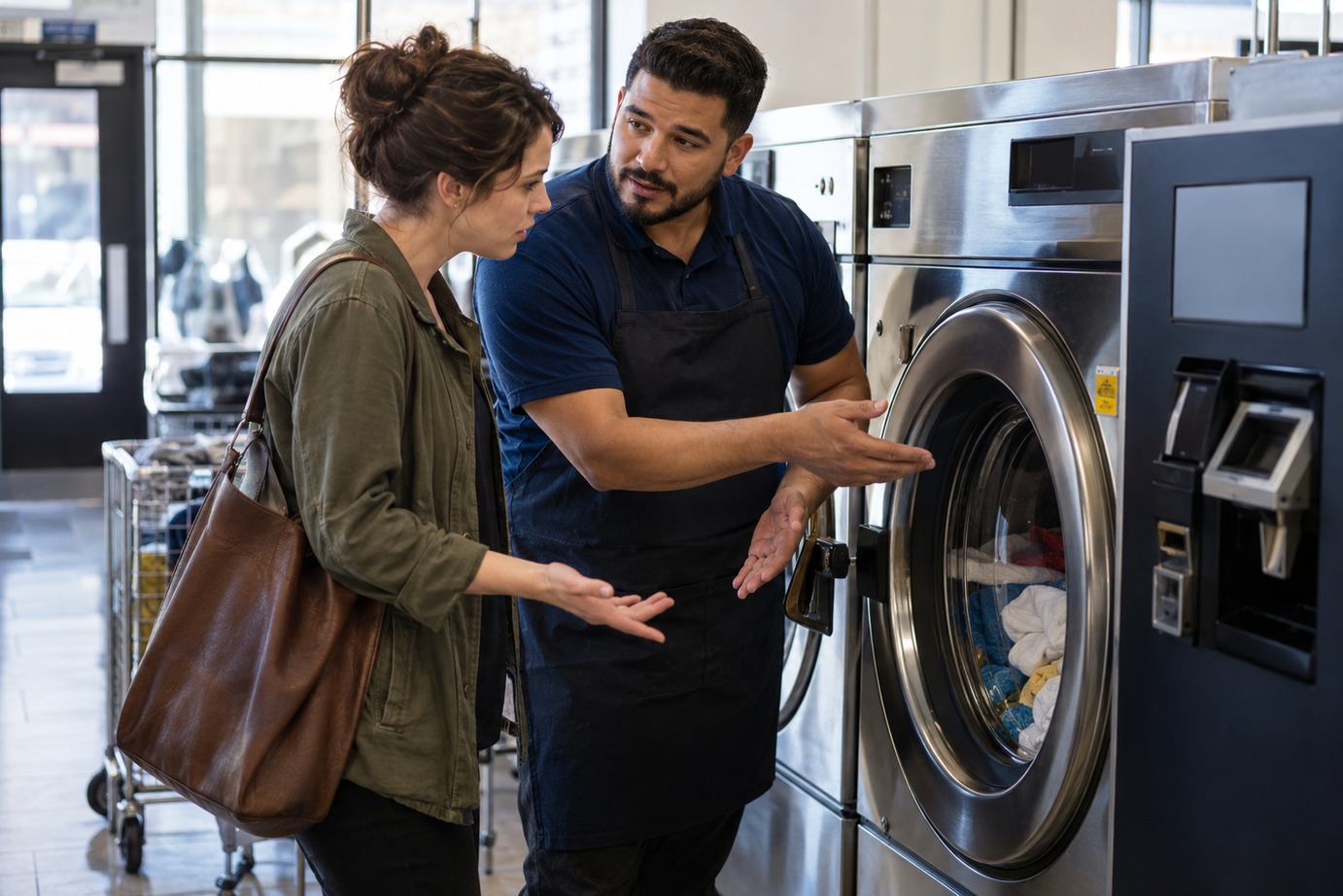
Laundromat Payment Accepted but No Cycle: Customer Support
A coin-laundry customer reports that payment was accepted but the washing machine did not start. Within minutes, one local problem can become a complaint, a disputed refund and an unavailable unit for other visitors. The correct response is not automatically to ask for a second payment or try improvised adjustments. A simple process should separate customer assistance, evidence gathering and technical intervention. The workflow below is for self-service laundry operators and support staff regardless of the chosen payment technology.
Receive the report without deciding the cause immediately
Ask which machine the customer used, approximately when the incident occurred and what happened on the screen or payment device. Do not automatically blame user error, the payment mechanism or the washer. A rejected transaction, accepted credit that did not trigger a start and a unit already unavailable are different situations. The checks staff can perform depend on the installed system and their authorised access. Avoid collecting full card details or other personal information that is not necessary to handle the case.
Keep the machine safe for other customers
If equipment displays a fault or behaves unexpectedly, follow the site's approved operating instructions and the manufacturer's guidance. Never ask users to open panels, bypass guards, force the door or alter connections. Where necessary, mark the unit temporarily unavailable under the site's procedures and contact qualified service support. This matters because a payment complaint should not turn into an unauthorised mechanical or electrical repair attempt. The safety of customers and employees comes before the speed of any transaction dispute.
Use a short but complete incident record
The report should be understandable to someone who was not present. Include machine ID, date, approximate time, payment method as reported, observed message if available and the action taken. If contact details are needed for a response, process them under applicable privacy requirements. Do not invent system states that cannot be verified. When an administrative report is available, use an appropriate internal reference instead of sharing screenshots containing sensitive data or another customer's payment information.
| Record field | Neutral example | Purpose |
|---|---|---|
| Machine | Position 3 | Identify the unit |
| Time | 16:00–16:15 | Compare relevant records |
| Report | Payment reported, no start | Describe without diagnosis |
| Action | Support ticket created | Track resolution |
Separate commercial help from technical service
Customer support staff can explain authorised refund policies, give expected response times and log the problem. They should not take over checks of electrical supplies, sensors, wiring or payment interfaces. Repeat events affecting the same machine should be investigated by suitably qualified personnel familiar with the exact configuration. Any return to service must follow approved safety and maintenance instructions. Pressure to clear a waiting line is not a reason to override safeguards or declare a fault fixed without checking it.
Use the rules of the actual payment system
Evidence available for a token transaction differs from a central payment station or a cashless method. Never assume a device records an event simply because another brand or configuration does. When specifying industrial washers for a coin-operated project, ask before ordering how starts, interruptions, refunds and assistance will be handled. Compatibility with the selected payment arrangement must be technically confirmed and documented, not presented as a universal guaranteed feature.
Close the case only when the outcome is clear
Use simple status labels: report received, administrative review, refund decision, technical intervention if required and closure. Closure should record what was communicated to the customer and what made the machine usable again, where applicable. Do not delete the event just because a refund was issued. Previous reports help identify recurring faults and unclear instructions. Periodically review incident counts by machine, time to resolution and how frequently a human operator must intervene for the same kind of failure.
For a broader project review, consult laundry equipment catalogue. For ways to make customer instructions clearer before incidents arise, see the customer-instruction guide.
Frequently asked questions
Should a customer be told to pay again immediately?
Not as an automatic response. Follow the approved procedure, check what evidence is available and explain the options that apply to the installed payment system.
Does issuing a refund prove that the washer is defective?
No. A refund may be a commercial decision. Establishing a technical cause requires evidence and, where necessary, qualified diagnosis.
A useful support workflow protects the customer, operator and equipment simultaneously. Collect a few accurate facts, stay within authorised technical responsibilities and record the outcome. That is more effective than assigning blame quickly or promising features that have not been confirmed for the installed machine.
Rehearse a complaint before it happens
During staff induction, ask an operator to respond to a hypothetical case: a customer reports a completed payment, the washer has not started and other customers are waiting behind them. Check whether staff can capture minimum evidence, mark the unit appropriately and follow authorised refund rules without making unsupported promises. Repeat the scenario for different payment methods only if those methods are genuinely installed. The exercise should end with a ticket another employee can understand. It tests the support process, not the electronics inside the payment mechanism.