

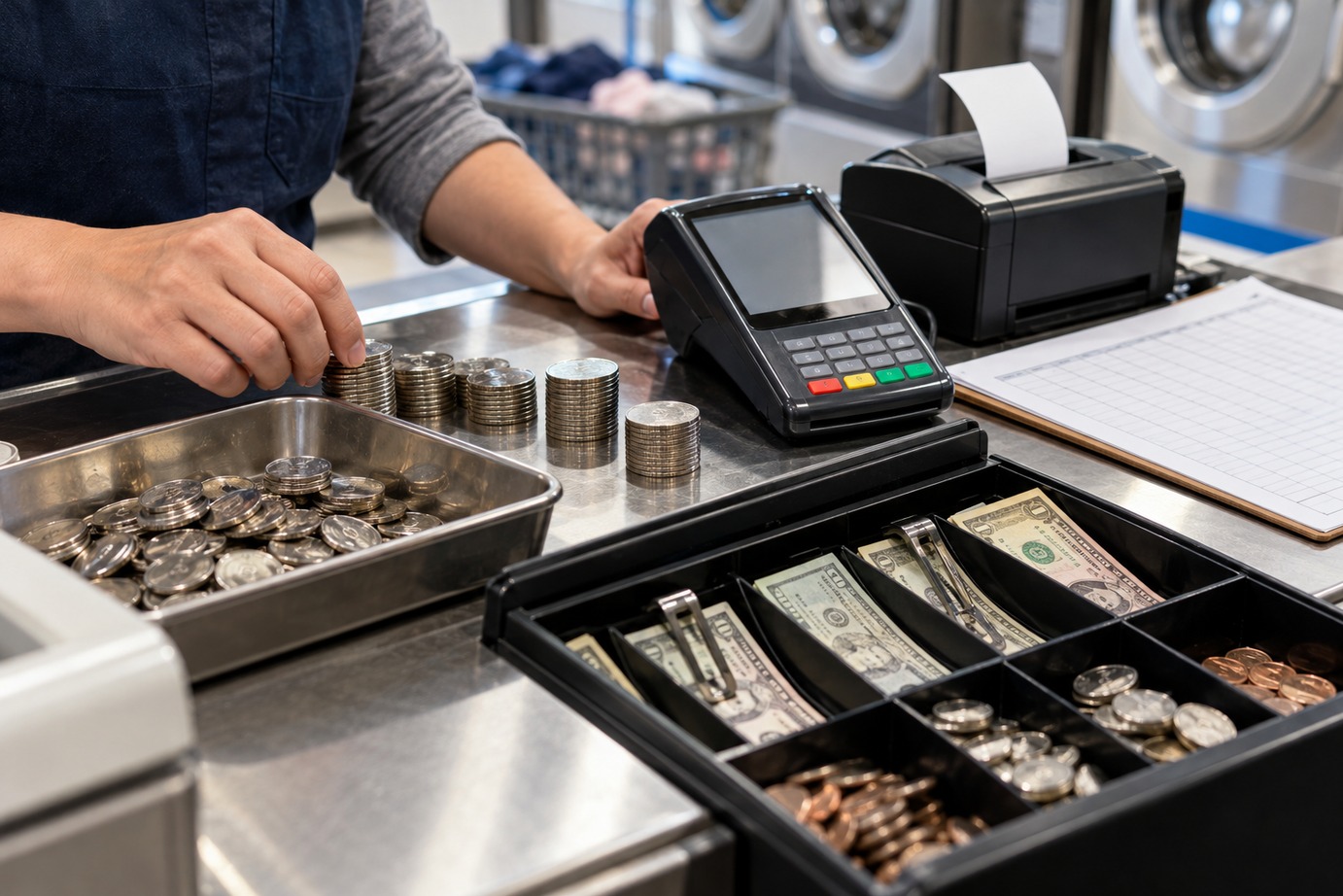
Tokens and Cashless Payments: Reconcile Laundromat Revenue
In a coin-operated laundry, takings are not always identical to the number of completed cycles the owner can see. Transactions may be cancelled, refunded or credited, and faults can create differences between payment events and actual machine starts. When tokens and digital payments coexist, daily reconciliation requires a method that matches the system installed at the site. This is not a guide to altering electronic or fiscal equipment. It is an operating framework for collecting information that the operator, payment provider and qualified accountant can review consistently.
Define the transaction events being counted
Before counting revenue, establish which events the installed system can record: accepted payment, credited balance, permission to start, actual programme start and refund. Do not assume every device produces all these reports or that the events represent the same thing. A conventional token mechanism may require different checks from a cashless system. Use the manufacturer's definitions and set up a register that does not confuse cash received, tokens physically collected and services already delivered. Tax and accounting obligations must be checked with a qualified adviser under the rules applying to the business.
Prepare a simple end-of-day reconciliation
For each payment channel, record the relevant reported total, customer exceptions and authorised refunds. Do not double-count a token when it is sold and later collected if that would record the same transaction twice. An illustrative day might show twenty payments, eighteen observed cycle starts, one authorised refund and one unused credit. The difference does not establish a loss: the events need to be classified under the rules of that particular platform. Keep enough information to review discrepancies without collecting unnecessary personal or payment-card data.
| Illustrative event | Count | Evidence to check |
|---|---|---|
| Recorded payments | 20 | Available transaction report |
| Observed starts | 18 | Compatible machine event log |
| Approved refund | 1 | Authorisation record |
| Unused credit | 1 | Provider's accounting rules |
Investigate discrepancies without touching electronics
When figures differ, note the date, approximate time, machine number and kind of exception. First review the administrative instructions for the payment platform and any refund already documented. Do not open electrical enclosures, change token mechanisms or bypass safety features merely to force numbers to match. Communication, wiring and sensor checks are the responsibility of qualified service personnel. Store staff should be able to collect observations and raise an intelligible ticket without diagnosing hardware or making unsafe adjustments.
Payment compatibility depends on the exact washer
Projects requesting coins, cards or digital terminals need to define the desired payment method before obtaining a quotation. KENLE notes that compatibility of industrial machines proposed for coin-operated laundries must be verified for each model and configuration; payment equipment is not automatically standard across the range. Document who supplies the payment device, the event data available, support responsibilities and refund procedure. Do not attribute an optional function or third-party integration to every washer as if it were guaranteed.
Match customer incidents against payment records
A complaint that payment was accepted but a washer did not start should result in a consistent record, whether or not the store ultimately issues a refund. A minimal sheet includes machine, time window, reported payment method, outcome and action taken, subject to privacy rules. Avoid asking customers for photos of entire payment cards or other unnecessary sensitive information. Multiple incidents on the same machine warrant an equipment service ticket rather than treating each complaint as unrelated. Reconciliation can reveal recurring technical problems before they undermine trust.
Set responsibilities and internal checks
Define who collects tokens, authorises refunds and signs off the day's register. Duties and controls should be appropriate to the size of the business and local requirements. Store records according to applicable retention obligations and professional accounting advice. When comparing daily totals, also record pricing changes and machine availability; otherwise a revenue change might be blamed on electronics without evidence. Procedures should be understandable to the next manager, auditable and usable even when the normal employee is absent.
For the wider machine and payment configuration, review industrial washing machine range. To distinguish revenue reconciliation from checking an individual payment event, see the payment validation guide.
Frequently asked questions
Are payment and cycle start always the same event?
No. Some systems distinguish accepted credit, authorised transactions, start permission and actual machine activity. Confirm what the installed arrangement records.
Does a discrepancy mean the coin unit must be replaced?
No. First classify refunds, unused credits, operating errors and possible faults. Only an appropriate technical assessment can establish whether equipment repair is necessary.
Credible reconciliation is not about forcing every number to agree through guesswork. It is about explaining each exception and retaining evidence. Consistent records, clear support responsibilities and sensible checks make a laundromat easier to manage without promises about undocumented technology.
Review exception patterns monthly
Alongside the daily register, group exceptions by machine, payment method and refund reason. If discrepancies repeatedly occur in one time window, first check for known outages, promotions or shift changes. Do not use aggregate figures to assign personal blame without evidence. A monthly review may justify clearer customer instructions, extra staff training or an authorised service check. It must remain separate from formal accounting and tax obligations handled by the relevant qualified adviser.