

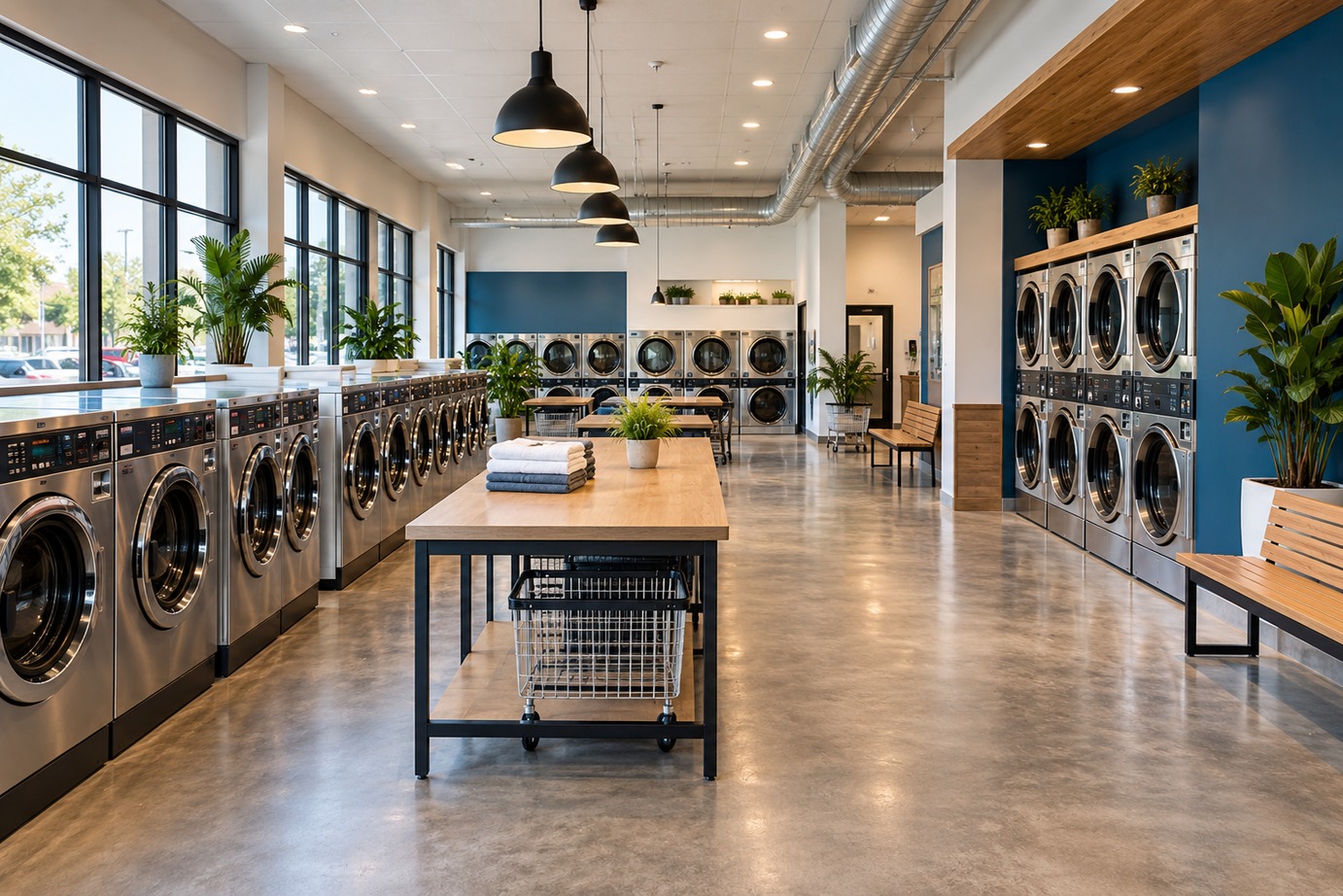
Self-Service Laundromat: Design the Customer Journey
A self-service laundry customer should be able to enter, identify the right machine, move with a basket, dry and fold clothes without obstructing others. A store equipped with excellent washers can still generate delays if movement is confusing or an open drum door blocks the main route. Designing the customer journey means observing the complete visit rather than merely arranging machines along a wall. The review must combine operational needs, accessibility and applicable local requirements, with technical advice from the responsible professionals.
Make the next step obvious from the entrance
From the front door a customer should recognise the wash area, the selected payment arrangement and any essential instructions. Signs cannot compensate for an ambiguous circulation route where people must cross paths with heavy trolleys. Mark the proposed customer route on a floor plan and walk through it. Instructions should be understandable, accessible and consistent with local rules. Do not assume that every visitor already knows how the equipment operates or the correct sequence for washing, drying and collecting textiles.
Test routes with machine doors open
A plan can look spacious with every door closed and become impractical during real loading. Rehearse movements using the actual dimensions of candidate machines and the baskets available to customers. Check the route while a washer door is open, one person is unloading and another is heading to the dryers. Preserve the clearances required by installation instructions, maintenance needs and qualified design; avoid applying invented universal distances to every building. Examine potential conflicts near the entrance, payment area and emergency exits as well as between machines.
Give each part of the visit a usable space
The main tasks are loading, waiting, transferring, drying, folding and leaving. Place them on the plan so the customer does not repeatedly cross the busiest part of the room. Access for cleaners and maintenance technicians should not rely on squeezing through the most congested route. In a small site, fewer genuinely usable stations may be better than a dense arrangement of equipment. Test a peak-hour scenario with several people and baskets at once rather than assessing the empty premises on a quiet morning.
| Journey point | Question to test | Suggested observation |
|---|---|---|
| Entrance | Are machines and instructions easy to find? | Stand at the door |
| Washing | Is there room with doors open? | Rehearse with a cart |
| Transfer | Is the route to dryers clear? | Walk the full path |
| Folding and waiting | Can tasks happen without obstruction? | Simulate a busy period |
Position payment and customer support carefully
If the project uses a token station, card reader or central payment point, its placement should not force every customer to wait directly in front of operating machines. Do not assume that all payment technologies work with every washer model; compatibility must be confirmed for the selected configuration. Put instructions where people need to act instead of covering walls with excessive text. Provide a straightforward way to request support when a machine is unavailable or does not start. User-facing guidance must never suggest opening technical panels or bypassing safety systems.
Make cleaning and maintenance part of the layout
Staff must be able to clean floors, folding areas, surfaces and spaces around equipment without continually blocking users. Allocate sensible places for waste disposal and service tools. If a cleaning cart must cut through customers moving heavy loads every hour, reassess the route or operating schedule. When reviewing washing equipment for a laundromat, consider usable machine access, transfer towards the dryers and future service access as well as nominal drum capacity and cabinet dimensions.
Test the plan with different people
A useful trial includes people with different heights, physical abilities and familiarity with self-service equipment, while respecting applicable accessibility rules. Ask participants where they cannot find instructions, where waiting occurs and where a laundry basket becomes awkward to move. Record those issues before committing to furniture and machinery. This practical rehearsal is not a substitute for professional safety or building-code assessment. Its purpose is to reveal usability failures that may not be obvious from a drawing. After opening, check whether actual peak periods confirm the expected flow.
Check the proposed circulation route against the industrial laundry equipment. To complement the physical customer route with clearer operating instructions, read the customer-instruction guide.
Frequently asked questions
Is a wide corridor on the floor plan enough?
No. Open doors, trolleys, handling movements, maintenance and actual accessibility requirements all affect usable width and passage.
Should a small laundromat maximise its number of machines?
Only if customers can reach and use them safely. More drums do not guarantee more throughput when transfers and folding create congestion.
A successful layout is judged by what customers can actually do: find the service, move textiles without conflict and understand each step. Before confirming a purchase or installation, rehearse the full customer journey with realistic equipment dimensions and workloads.
Record usability findings before committing to equipment
The route rehearsal should produce a short dated record naming participants, observed problems and proposed changes. Mark on the plan where someone had to stop for a trolley, where an open door obstructed passage and where instructions were overlooked. Ask the responsible professionals to confirm that the resulting layout satisfies relevant building and technical constraints. Keeping a usability test separate from a formal design check is particularly important in existing premises with limited available space.