

Laundry Productivity: Reducing Waiting Times and Bottlenecks
Laundry productivity is not just the nominal capacity of a washer. It also depends on sorting, loading, unloading and the time textiles spend waiting between washing and drying. In this article we look at how to identify workflow bottlenecks and organize operations before deciding whether new equipment is necessary.
Where does laundry time get lost?
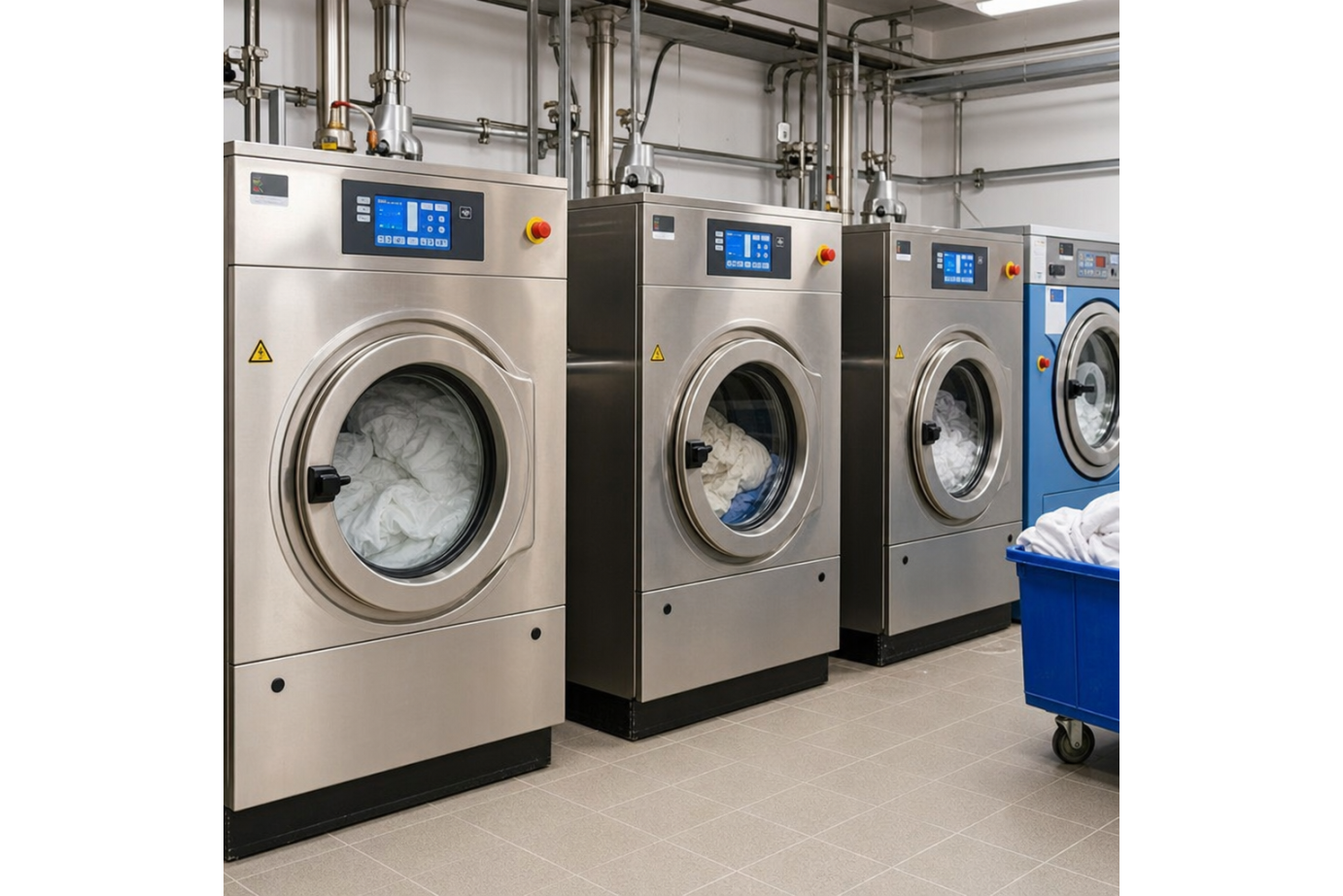
Industrial washing machines have transformed productivity because they allow large volumes of linen, uniforms, or technical textiles to be processed with more stable, repeatable cycles, suitable for intensive use. Compared to domestic solutions, they are designed to run for many hours a day, reducing downtime and maintaining more consistent results. The advantage is not just "washing more," but better organizing the flow: loading, washing, drying, folding, and return become more predictable phases.
In many businesses, clean textiles aren't just a detail: they're part of the service. A ready hotel room, a streak-free tablecloth, a sanitized uniform, or a towel available at the right time impact the customer experience and the company's reputation. When laundry is slow or unreliable, the entire supply chain slows down.
From manual labor to controlled process
The first real revolution introduced by industrial washing machines is the transition from fragmented work to a measurable process. Instead of relying on continuous manual intervention, the operator can select programs suited to the type of soiling, the fabric, and the required level of hygiene. This reduces errors, waste, and rework.
A well-designed cycle helps protect garments, consume water and energy more efficiently, and use the right amount of detergent. For a business, these aspects have tangible value: fewer damaged fabrics, less time wasted rewashing, and greater continuity of service.
The most obvious operational benefits
Companies introducing or upgrading an industrial washing system are primarily looking for efficiency. The most significant advantages are:
These elements don't eliminate the need for good management, but they simplify it. Technology truly works when it's integrated into a clear routine: sorting clothes, choosing programs, maintaining them, and monitoring results.
The role of industrial detergents for washing machines
Industrial detergents for washing machines are an essential part of the result, not a secondary accessory. A high-performance machine, if combined with unsuitable products, can result in incomplete washes, residues on fabrics, or unnecessary consumption. On the other hand, a properly chosen professional detergent works in synergy with temperature, mechanical action, and cycle duration.
The choice depends on several factors: fabric type, nature of the soiling, required level of hygiene, water hardness, and washing frequency. In a restaurant, for example, grease and food stains require a different approach than spa linens or work uniforms. Dosage also matters: too little product may not clean thoroughly, while too much product can leave residue and increase costs.
Best practices for more efficient washing
To achieve consistently professional results, it is useful to follow some operating rules:
- Separate textiles by color, fiber and degree of soiling , avoiding mixed loads that are difficult to handle.
- Do not overload the drum , because an excessive load reduces the mechanical action and worsens the rinsing.
- Use programs appropriate for the material , especially for delicate fabrics, sponges, sheets and technical uniforms.
- Check the dosage of detergents , preferably with clear and repeatable systems.
- Periodically check filters, gaskets and trays to maintain performance and hygiene.
These habits seem simple, but they significantly impact productivity. A correct cycle the first time is worth more than a quick repeat.
How much do industrial washing machines impact business costs?
Industrial washing machines impact business costs in two ways: they require an initial investment, but they can reduce waste, operating times, and inefficiencies in the medium term. When looking for information on industrial washing machine prices , it's important to look beyond the purchase price. A true comparison should include capacity, consumption, expected lifespan, maintenance, service availability, and compatibility with the detergents used.
A seemingly inexpensive machine can become expensive if it can't keep up with your workload, consumes too much fuel, or requires frequent maintenance. At the same time, a more advanced model isn't always necessary if volumes are limited. The best choice comes from balancing real needs with growth prospects.
Which indicators should you track before investing?
Before investing, it is worth clarifying some practical aspects:
Evaluating these factors helps you read prices more intelligently. You're not just buying a washing machine: you're building part of the production process.
Productivity also means perceived quality
When it comes to productivity, we often think only of quantity. In reality, in a professional laundry, perceived quality also matters: clean, soft fabrics, free of unpleasant odors, and delivered on time. Consistent results reduce complaints, improve the service's image, and make the work of those managing internal deliveries easier.
For a hotel, available and well-maintained linens mean less stressful room preparation. For a restaurant, well-kept table linens contribute to the atmosphere. For a sports facility, clean towels and uniforms convey attention and order. Productivity, therefore, isn't just a technical skill: it's a lever of experience.
A small checklist to immediately improve the washing department
Even without immediately changing equipment, many businesses can improve washing efficiency by reviewing their methods. Here's a helpful checklist:
Answering these questions allows us to identify hidden bottlenecks. Often, the technology is already there, but it's not being used to its full potential.
Conclusion
The Industrial Revolution: Industrial washing machines and their impact on productivity aren't just about larger or more powerful machines. It's about a more organized, reliable, and professional way of managing laundry. With the right equipment, carefully selected industrial washing machine detergents, and well-defined procedures, every cycle can save time, protect fabrics, and improve service.
Track delays before each step, the frequency of partly filled loads and whether extraction is slowing the drying process. Equipment investments should follow this diagnosis and solve a documented constraint rather than replace sound scheduling.
To see whether delays come from the handover between departments, read the washing-to-drying queue measurement. As daily throughput rises, evaluate the 18–30 kg industrial washer range against batches, cycles and available working hours.