

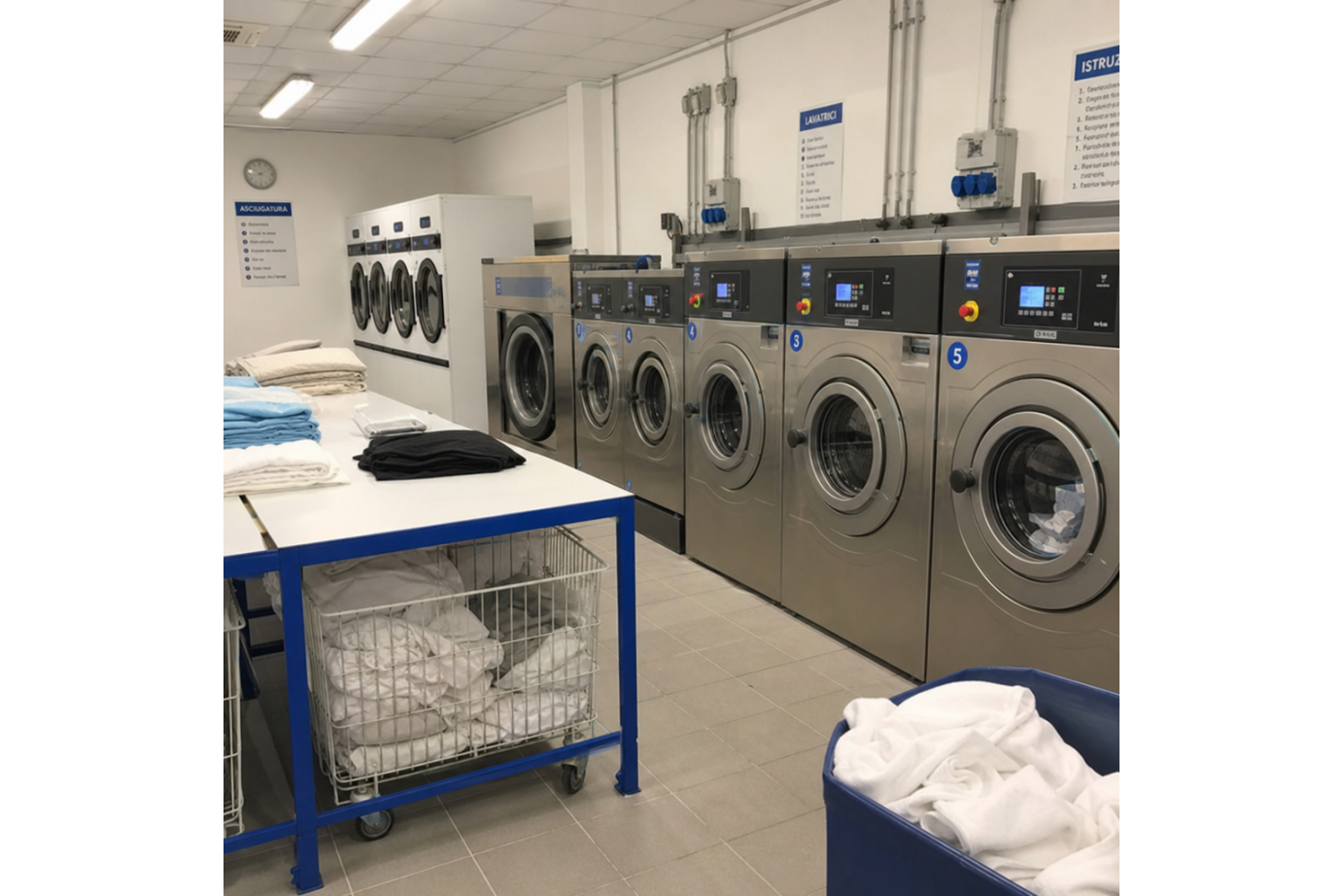
Commercial Laundry Budget: Planning the Investment
A commercial laundry investment plan should separate one-time costs, recurring expenses and an allowance for unforeseen work. Machinery prices matter but do not reflect the full amount needed to open or renovate a laundry. This article organizes the main operating-budget items and checks to make before committing capital.
What assumptions are needed for the budget?
The starting point is to define the laundry model, the expected volume, and the type of service offered. A self-service laundromat, a wash-and-fold service, a hotel or restaurant business, or a business offering more specialized services don't all have the same requirements for machines, staff, space, and technology. Therefore, planning your investment in commercial laundry equipment doesn't just concern the price of the machines, but the entire operating system.
Before asking for quotes, it's a good idea to clarify some essential elements:
These answers will guide your choice between industrial washing machines, professional washing machines, industrial dryers, and professional dryers, avoiding purchasing valid equipment that is unsuitable for your project.
The budget must include more than just the machines
Many investment plans start with the cost of the machines and ignore expenses that become crucial before opening. For a small commercial laundry, the initial investment can often be between €30,000 and €60,000, while larger or more specialized setups can exceed €100,000. Industrial washers and dryers alone can cost approximately €15,000–€40,000, depending on capacity, technology, number of units, and level of automation.
In addition to these costs, there are items that must be considered from the beginning:
- Renting or buying a space Location has a significant impact on profitability, especially for self-service restaurants. A visible, accessible space, close to the right audience, may cost more, but it reduces sales effort.
- Technical upgrades and renovations : Plumbing, drainage, ventilation, electricity, gas, flooring, and soundproofing can require major work. In many projects, the initial rent and construction costs can add several thousand euros to the budget.
- POS payment and management systems , cashless payments, apps, coin acceptors, monitoring software, and tools for tracking machine usage improve control and convenience.
- Installation, training and start-up A machine installed poorly or used without correct procedures can cause downtime, consumption and premature wear.
- Supplies and consumables Detergents, fabric softeners, bags, labels, trolleys, furniture, and operating accessories are not just small details: they make the service smooth and professional.
- Maintenance and contingency fund: Even the best equipment needs regular checks. Including a reserve in your budget helps ensure your business doesn't shut down at the first problem.
Choose machines based on service
Professional washing machines are suitable for frequent loads and more intensive use than domestic machines, while industrial washing machines are designed for high volumes, continuous cycles, and environments where productivity and robustness are priorities. The choice depends on the average load, the type of fabric, the time available per cycle, and the expected wash quality.
Professional and industrial dryers deserve the same attention. A quick wash loses value if drying creates bottlenecks. In self-service facilities, rapid turnaround times and simple interfaces improve the customer experience. In commercial services, capacity, drying consistency, and consumption directly impact margins.
For a more rational choice, it is useful to evaluate:
New or used: which is the best choice?
Used machines can reduce the initial outlay, but they need to be evaluated in terms of remaining life, warranty, fuel consumption, availability of spare parts, and maintenance history. A cheap used washing machine may seem convenient, but it can become expensive if it consumes a lot of power, requires frequent repairs, or doesn't support the services you want to offer.
New, on the other hand, requires more capital but can offer more efficient technologies, modern interfaces, integration with management software, and greater predictability. It's not always the only option, but it's often more attractive when the plan aims to reduce consumption, automate processes, or build a modern service image.
A proper evaluation should compare the total cost of ownership, not just the purchase price. This means adding together the initial investment, estimated fuel consumption, maintenance, downtime, spare parts, expected lifespan, and operating value over time.
Efficiency, technology and ROI must be designed together
The return on investment depends not only on the number of machines installed, but also on how well they function within the operational flow. Automation, digital monitoring, integrated payment systems, and consumption control can reduce errors, waste, and downtime. In a self-service laundry, for example, a clear interface and simple payments make the service more accessible; in a serviced laundry, cycle tracking helps staff better organize their work.
To improve ROI, it's best to think on three levels:
Even the layout of the machines matters. Confusing routes, insufficient carts, or awkward waiting areas slow down work and degrade the perception of service. A well-designed laundry makes every step feel natural: delivery, washing, drying, folding, payment, and pickup.
Checklist for validating the investment plan
Before signing an order, it's helpful to turn the idea into an operational checklist. This step reduces emotional decisions and allows you to compare suppliers and quotes with clearer criteria.
Essential checklist:
The best choice is the one that is sustainable over time
Planning your laundry equipment investment means balancing initial capital, service quality, and future costs. The right machines aren't necessarily the largest or most expensive, but those that support your business model, reduce waste, and maintain high operational continuity.
Complete your plan with comparable technical quotations, stated workload assumptions and a contingency allowance. Once the budget is clear, it becomes easier to select an equipment configuration in line with the service goals and financial limits.
To separate the initial investment from lifetime running costs, read the review of total washer ownership cost. In a quotation for a compact laundry setup, include the 10–15 kg industrial washer range as one capacity band to assess.