

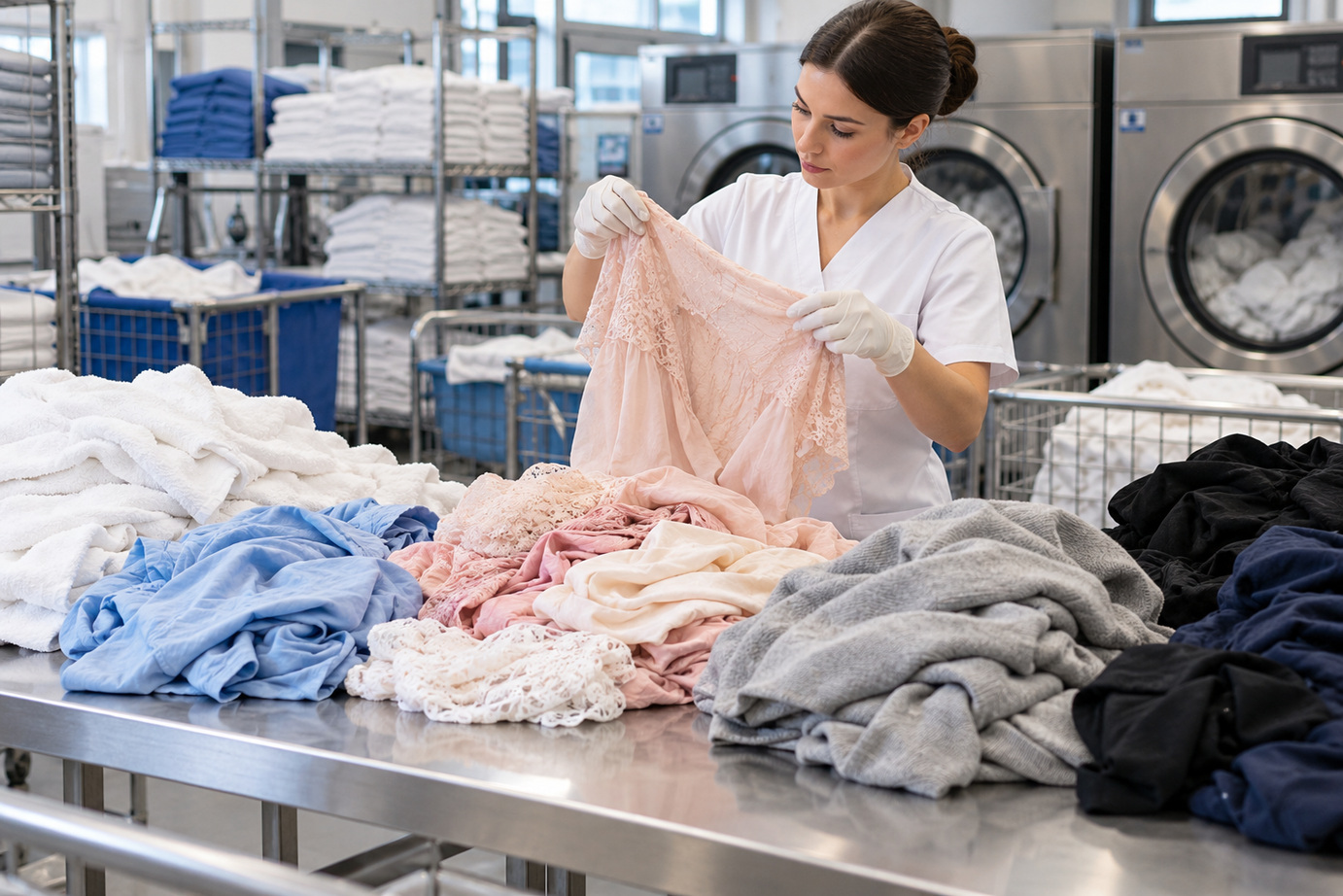
Mixed Laundry Loads: When Delicate Fabrics Must Be Separated
Professional laundry sorting involves much more than separating whites from colours. Two items of the same colour can require different treatments; two items from the same customer can carry different types of soil. The practical question is which textiles can share a programme without compromising cleaning, fabric integrity or the service specification? This guide concentrates on load compatibility rather than repeating a general introduction to sorting.
Five factors to check before combining items
Start with care labels, fabric composition and construction, dye-transfer risk, type of soil, and any process requirements agreed with the customer. A robust uniform and a delicate garment do not become compatible just because both are blue. Where a hygiene procedure requires separation, filling the machine is never a reason to bypass that requirement.
Imagine a facility receiving cotton table linen, technical jackets, terry towels and uniforms with reflective trims. Some items may have incompatible care instructions even when they arrive on the same trolley. Membranes, prints, applied decorations and special finishes need particular attention to the textile maker's guidance.
A practical compatibility matrix
The following is a decision aid, not universal permission to wash the listed groups together.
| Proposed combination | Main issue to assess | Working decision |
|---|---|---|
| Sheets and pillowcases from the same service | Colour, fabric and care requirements | Combine only when all constraints align |
| Terry towels and lightweight linen | Mechanical action, uneven movement and timing | Often more predictable as separate loads |
| New dark items and pale linen | Dye transfer | Separate until the risk is understood |
| Printed technical garments and robust cotton | Different treatment limits | Follow the stricter instructions or split |
| Heavily soiled workwear and normal linen | Cross-contamination and rewash risk | Keep separate according to the site's procedure |
A compromise temperature is not automatically acceptable. An overly gentle programme may fail to clean the load, while an aggressive one may damage the most vulnerable item. If requirements conflict, the practical answer is separate processing.
The hidden cost of a mixed load
Filling a drum with incompatible goods may look efficient at the start of the shift but result in rewashing, customer complaints or replacement of damaged items. Track three indicators by textile group: rewash batches, items rejected after cleaning and extra sorting time. The time spent identifying which customer owns a disputed garment is a real operational cost too.
Do not confuse drum volume with actual load mass. A machine filled with bulky lightweight textiles behaves differently from one loaded with compact heavy garments. Industrial washing machines must be used within the limits set for their particular model and programme, and compatible items should still be weighed or otherwise assessed appropriately.
Three real-world sorting scenarios
Hotel laundry: table linen with stubborn food stains may need different treatment from bed linen even when both are white. Separating them can improve consistency and reduce rework, but the actual approach depends on the hotel's process.
Spa or wellness centre: towels may carry oils or cosmetics. Follow the defined pretreatment and wash requirements; never improvise incompatible chemical mixtures. Accurate sorting prevents a problem affecting an otherwise ordinary batch.
Professional uniforms: reflective features, protective finishes and specialised textiles may have strict care requirements. Customer specifications and garment documentation take precedence over a generic rule based solely on colour or garment weight.
Make decisions reproducible across shifts
Create a sheet with four fields: textile family, authorised programme, common incompatibilities and what to do when information is missing. Keep it near the area where batches are assembled rather than solely by the washer display. Define who can approve an exception and how it is recorded. Update the document when a textile supplier or customer specification changes.
Remember that wash compatibility does not guarantee drying compatibility. A mixed group might tolerate the same wash but need different heat exposure afterwards. Check garment limitations against available professional tumble dryers and avoid forcing unsuitable items through a shared drying cycle.
Five questions before pressing Start
Are every item's care instructions compatible? Has colour transfer been considered? Are hygiene rules being respected? Are load mass and bulk appropriate for this programme? Could the team explain why these goods were processed together if a customer complained? When an answer is unclear, check before starting the cycle. That takes less effort than reconstructing a failure after the load is finished.
For a specific example involving technical textiles, explore the precautions for drying technical sportswear.