

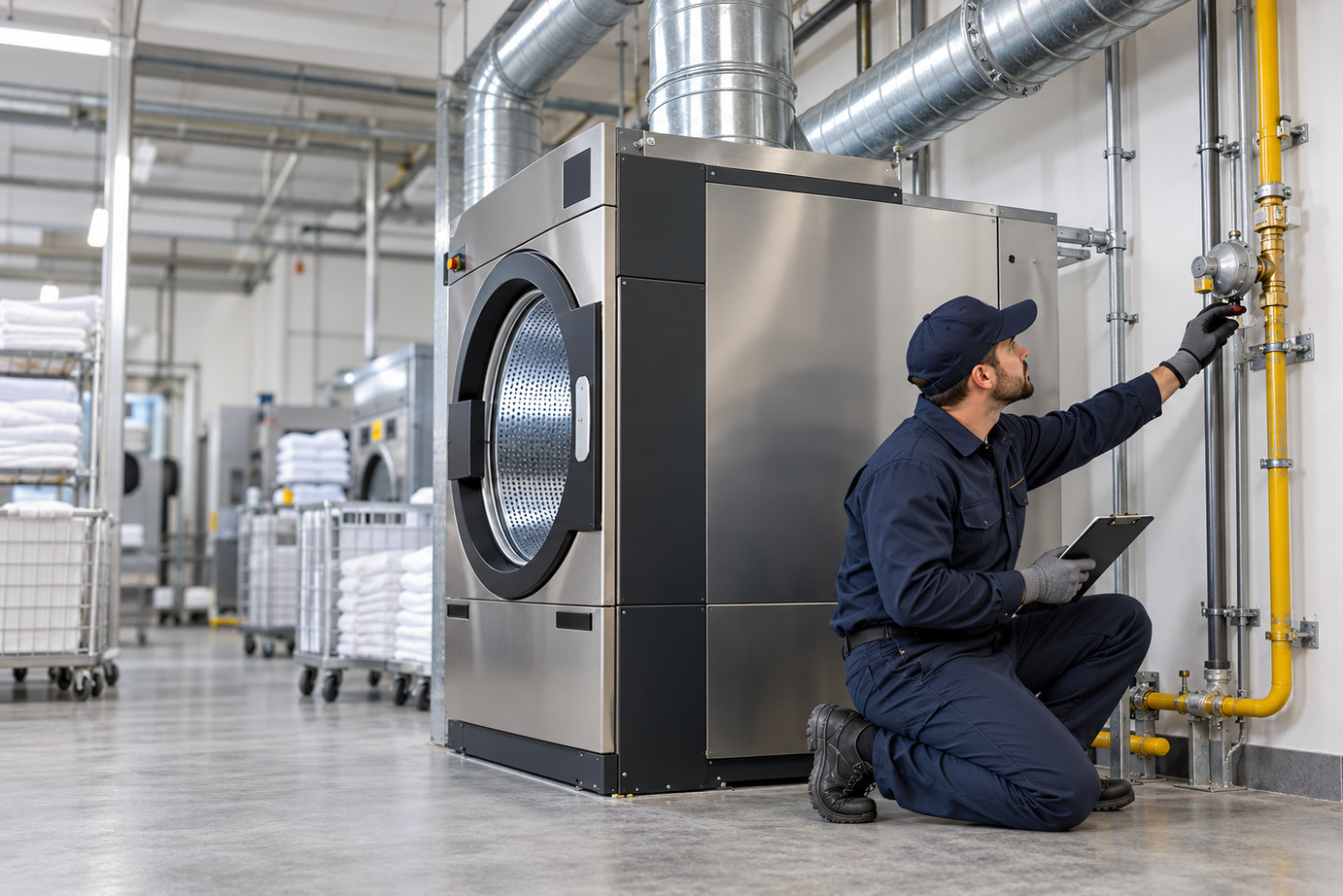
Gas-Heated Industrial Dryers: Checks Before Installation Planning
Choosing a gas-heated industrial dryer involves far more than comparing fuel prices. The project depends on whether natural gas or LPG is available, the exhaust route, combustion and make-up air requirements, maintenance access, and applicable local rules. A quotation based only on drum capacity may leave out essential building work. This checklist helps a laundry manager assemble the right information; it is not a do-it-yourself installation guide.
Confirm what utilities the building actually provides
Collect a floor plan, photographs of the technical area, and available details of the site's energy connections. The fact that a building uses gas does not prove that a suitable connection, supply conditions or permissions exist for a proposed machine. Electrical capacity, steam supply and other utilities may also matter when comparing alternative configurations. Suitable heating versions must be confirmed for the particular model.
Do not assume that equipment specified for natural gas can use LPG without the appropriate manufacturer-approved configuration. A qualified installer or designer must assess the fuel, site conditions, rated equipment and required protections. Users should not adjust burners or change gas components themselves.
Survey the room, not only the footprint
A meaningful layout shows how the machine door opens, where linen trolleys pass and how service staff reach the relevant components. A qualified specialist must assess exhaust routing, fresh-air provision, ventilation and any other requirements stated by the manufacturer and local rules. A visually short duct is not in itself evidence of a suitable installation.
| Information to gather | Who should confirm it | Why it matters |
|---|---|---|
| Available fuel and supply conditions | Qualified designer or installer | Compatibility with chosen version |
| Exhaust route and make-up air | Mechanical or installation specialist | Safe and correct operation |
| Doorways, room dimensions and access | Site manager and supplier | Handling and service clearance |
| Electrical and other utility capacity | Relevant technical specialist | Powering the selected systems |
| Textile quantities and peak loads | Laundry manager | Capacity and workflow planning |
This list cannot replace the technical documentation, approvals or inspections required at the location. Its purpose is to reveal constraints before a purchase rather than after equipment is delivered.
Compare total cost, not only the energy unit price
Separate equipment purchase cost, installation work and operating cost. A fuel with a lower headline price might require building upgrades; an electric configuration may need different electrical provision; a steam option requires suitable plant and a machine version designed for it. No single energy option is always the cheapest across every commercial laundry.
Prepare a comparison that includes the quoted machine price, planned infrastructure work, maintenance scope, actual energy tariff, expected workload and the period over which the installation will be used. Be cautious about comparing catalogue consumption figures unless programme, load mass and incoming moisture are comparable. When requesting a proposal for industrial tumble dryers, describe the available utilities and ask for written confirmation of the heating options offered for the selected model.
Size the dryer for the existing workflow
A dryer must handle the real stream of loads coming from industrial washing machines, allowing for extraction performance and residual moisture. Record kilograms processed during peak hours, typical drying times by textile family, and whether damp loads accumulate. Matching rated kilograms alone does not establish actual hourly throughput.
For smaller, varied batches it may be worth assessing professional tumble dryers as part of a wider workflow design. In a high-volume operation, peak capacity, service access and the movement of trolleys become particularly important. The equipment must fit the whole process, not simply occupy the measured floor space.
Documents and responsibilities to settle before ordering
Ask for the exact model's technical sheet, installation instructions, required utility connections, maintenance clearances and the service and warranty terms. Clarify who designs the installation, performs connections, verifies compliance, commissions the machine and trains operators. These responsibilities should be recorded in writing, with a clear distinction between supplier scope and customer-provided works.
Before commissioning, the relevant qualified parties must complete the inspections and verification required by the chosen equipment and applicable rules. A sound commercial decision is one that leads to a verified installation, informed staff and a workable first production shift—not merely the quickest purchase order.
Before comparing heating options, read the comparison of gas, electric and steam drying.