

Towels Losing Absorbency: Checks After Repeated Washing
When towels in a hotel, gym or spa feel pleasantly soft but appear to absorb less water, age is not necessarily the only cause. Fibre composition, finishing treatments, residues from products, rinsing conditions and the way towels are used may all contribute. Customer perception matters, but it does not establish a technical diagnosis. A professional laundry can turn the complaint “these towels no longer dry properly” into a repeatable investigation rather than assuming that every loss of performance can be reversed by changing a programme.
Softness is not the same as absorbency
A towel may feel soft and still take up water less effectively than expected for its intended use. The opposite is also true: slight stiffness does not automatically make a towel defective. Perception depends on terry-loop structure, yarn type, finishing and drying method. Before attributing the issue to washing, compare items of the same specification and, where possible, from the same purchasing batch. A change of supplier may explain differences that otherwise look like a laundry problem.
If complaints come from only one department or customer, consider the point of use. A towel handed out while still warm or stored in a damp space may feel different from one that has cooled and been kept under suitable conditions. Any comparison should use pieces observed in similar circumstances.
Build a simple comparison without claiming laboratory accuracy
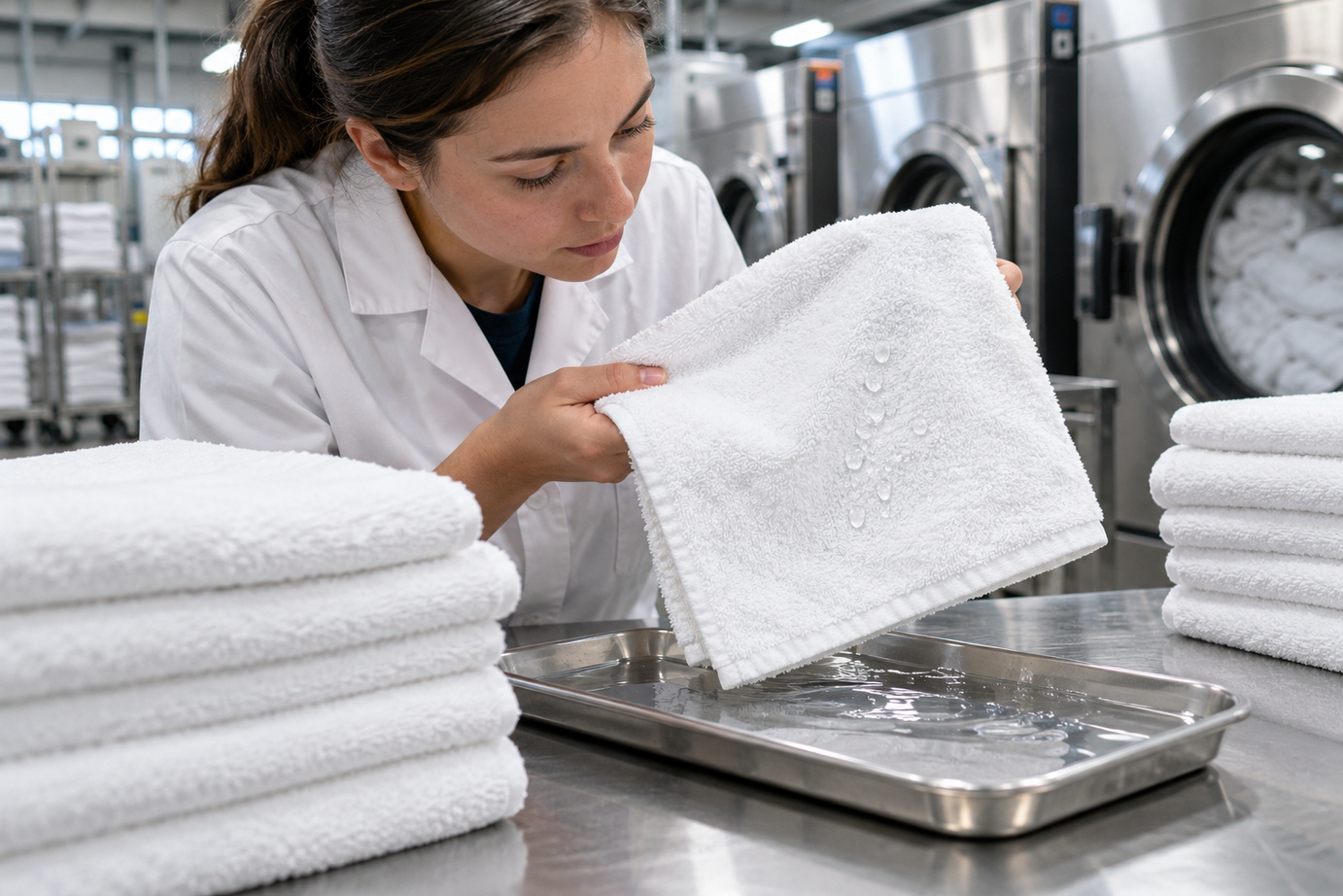
For an initial operational review, select two groups from the same towel type: items considered satisfactory and items that received complaints. Mark them with a temporary identifier and allow both sets to reach comparable room conditions. A consistently measured small amount of water can be applied to a similar area to observe differences in wetting behaviour under a documented internal procedure. This is a screening observation, not a certification of absorbency or a substitute for a recognised laboratory method.
Photographing the samples and recording date, approximate age, historical process and product used is more valuable than writing “absorbs poorly”. If the informal result is inconclusive, ask the textile manufacturer or a competent testing service before drawing commercial conclusions or disputing a supply batch.
Investigate potential process residues
Unsuitable chemistry, inaccurate product dosing or inadequate rinsing may leave residues or affect how terry fabric feels. Appearance alone cannot identify the cause. Review textile and chemical supplier guidance, examine dosing records and establish whether the issue began after a specific change. Do not introduce aggressive cleaning products simply to “restore” absorbency without checking compatibility and undertaking controlled trials.
To isolate a variable, avoid changing temperature, detergent, rinse stages and drying treatment at the same time. The comparison would be meaningless. In a department using professional washing machines, results depend on the approved programme, actual load and compatible textile chemistry rather than on any blanket promise of a universal recovery feature.
A manager's comparison sheet
| Question | What to establish | Evidence to retain |
| Textile reference | Are pieces comparable? | Supplier, label or batch |
| Usage history | Were they used similarly? | Department and age estimate |
| Chemical system | Was dose or product changed? | Recorded process specification |
| Rinsing | Are there known irregularities? | Cycle and incident logs |
| Drying | Is the final condition different? | Drying record and inspection |
This is an investigation checklist, not a compliance standard. Its purpose is to stop teams from blaming every complaint on equipment or every poor result on a faulty towel. Include examples that perform normally; they form a useful control group often missing from an investigation focused only on defects.
Separate drying effects from washing effects
The final feel of terry cloth also depends on drying and handling. An excessive or textile-incompatible process may affect durability, while an insufficiently dry result creates storage problems. When results vary among shifts, record both washing and drying information, including condition at the point of release. Decisions about professional tumble dryers should consider the actual fabric and the way finished quality is verified, not only nominal throughput.
There is no single ideal drying temperature for every towel. Work must remain within textile guidance and equipment limits. Before any permanent change, compare a small number of similar batches and include the people who check towels at the distribution point in the assessment.
Decide between process improvement and replacement
If one group of towels differs from the day it arrives, inspect its supplier specifications first. If performance changed after a chemical substitution, examine the revised procedure. If complaints affect pieces of different ages and origins, review the entire chain, including rinsing and drying. Some fabric damage may not be reversible, and replacement may be the only reliable option. Escalating to increasingly harsh cycles can make the situation worse.
For procurement and operations teams, track complaints per hundred towels inspected and the number withdrawn from service. These are local management indicators, not universal technical thresholds. The aim is a defensible relationship between customer experience, laundering practice and product durability, with decisions based on evidence rather than an impression that one load “feels different”.
To document terry-towel quality checks before delivery, see the end-of-cycle quality control sheet.