

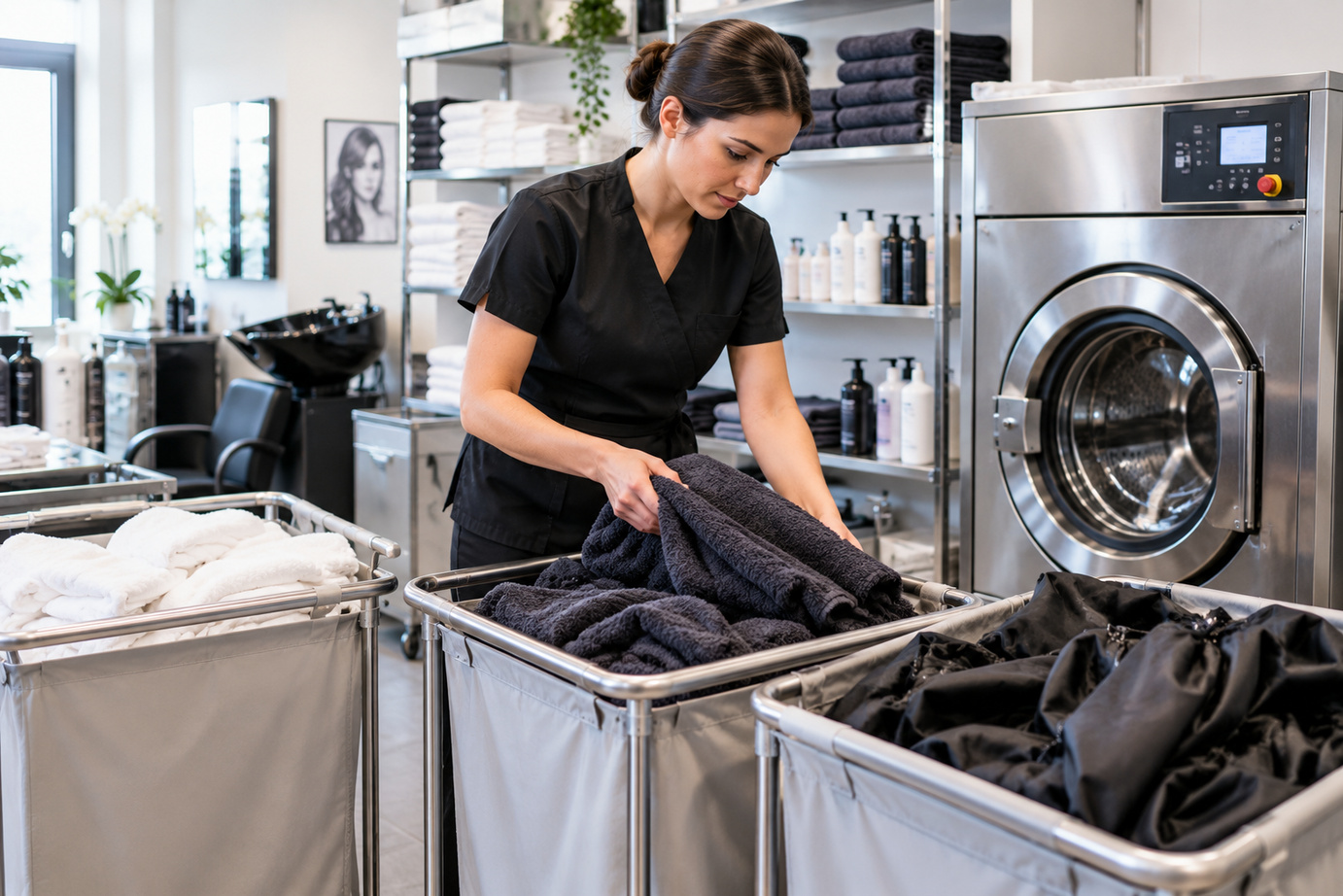
Salon and Beauty Studio Laundry: Organise 10–15 kg Loads
A hair salon or beauty studio creates small streams of laundry throughout the day: towels from shampoo stations and treatments, washable capes, spa textiles and cloths used for different tasks. Combining every item in one large load may look efficient, but it can cause colour, residue and availability problems. When assessing a 10–15 kg commercial washer, the goal is not to fill the drum at all costs. The goal is to return compatible textile groups to service before staff and customers need them, while following fabric labels and applicable workplace hygiene procedures.
Map the textile categories used by the business
List the towels used in each service, washable capes and other articles that genuinely belong in the laundry process. For each category, record colour, fibre composition, typical residues and manufacturer care requirements. Textiles exposed to specialist products should not automatically be treated like ordinary hand towels; check the relevant product safety information and established workplace procedures. Keep surface-cleaning cloths separate from textiles prepared for customer use. A useful classification reduces disagreements and emergency decisions before a wash programme is started.
Count items first, then use actual dry weights
Record the number of customers and the pieces used during different parts of the day, rather than assuming every appointment consumes identical linen. For illustration, suppose a studio collects 65 towels with a measured average dry weight of 180 g. That is 11.7 kg of towel material, before any separate and potentially incompatible capes are considered. If clean stock must be returned by midday, the operator cannot necessarily wait until closing to assemble the largest possible load. Programme selection and batch size must therefore respect real service deadlines as well as weight.
| Observation | Illustrative value | Operational decision |
|---|---|---|
| Towels collected | 65 items | Check availability time |
| Mean dry weight | 0.18 kg | Confirm with samples |
| Total dry towel mass | 11.7 kg | Sort for programme and colour |
| Washable capes | Weigh separately | Check manufacturer care rules |
A 10 kg rating does not mean equal usable volume
Two textile groups that both weigh ten kilograms can behave quite differently in a drum. Bulky terry towels and lightweight salon capes have different densities and require different movement during washing. Before deciding on a programme, check the permitted load for the material and actual equipment configuration. Models listed among KENLE's 10–15 kg industrial washers should be evaluated using representative batches, access, drying capacity and maintenance requirements, not just a headline kilogram figure.
Build a daily return schedule that staff can follow
Designate a dirty-textile collection point and a separate clean storage area. Decide who collects used towels, when the first batch is started, and who checks dryness before stock returns to the treatment rooms. A common operational error is scheduling one end-of-day wash and discovering that the studio ran out of towels during a busier afternoon. Test the proposed schedule against both an ordinary day and a peak Saturday. Include folding and redistribution time, since salon staff may be occupied with customers when the machine finishes.
Address cosmetic residues without guessing at chemistry
Hair colour, oils and professional treatment products can leave different residues. A useful record identifies the textile group, the service involved and the nature of the observed problem. Avoid improvised chemical combinations, mixing incompatible agents or presenting one treatment as suitable for all fabrics. Follow textile and detergent instructions, and obtain expert advice where a product presents specific risks. If washed towels become stiff or less absorbent, investigate the pattern before increasing dosage. A change that seems to improve one batch may reduce quality elsewhere.
Set clean-stock reserves around return time
The salon needs to know how many clean towels are on hand at opening and how many are likely to be consumed before the first clean batch is returned. An arbitrary reserve can either tie up stock unnecessarily or fail in peak demand. For one representative week, record issues, returns, items removed from service and urgent substitutions. Those observations help establish a minimum usable stock level and indicate whether the problem is machine capacity, staffing or irregular cart transfer. Regular availability matters more than a storeroom that merely looks full.
For relevant machine configurations and available programmes, review professional washing machines. For further guidance on separating the textile requirements of different services, see the guide to managing linen across services.
Frequently asked questions
Can capes and towels share a wash programme?
Only when their textile care requirements, residue types and relevant hygiene procedures are compatible. Filling the drum is not more important than safe handling or consistent textile quality.
Does a 14 kg washer eliminate small batches?
No. Colour, fibre type, soil category and availability deadlines may still require separation. A higher capacity should not encourage mixing incompatible articles.
The best salon laundry decision protects the service itself. Count items, weigh representative sorted groups, measure waiting periods and only then compare available machines. This approach can reveal whether the 10–15 kg band suits the business without inventing equipment features, universal chemical settings or unrealistic output promises.