

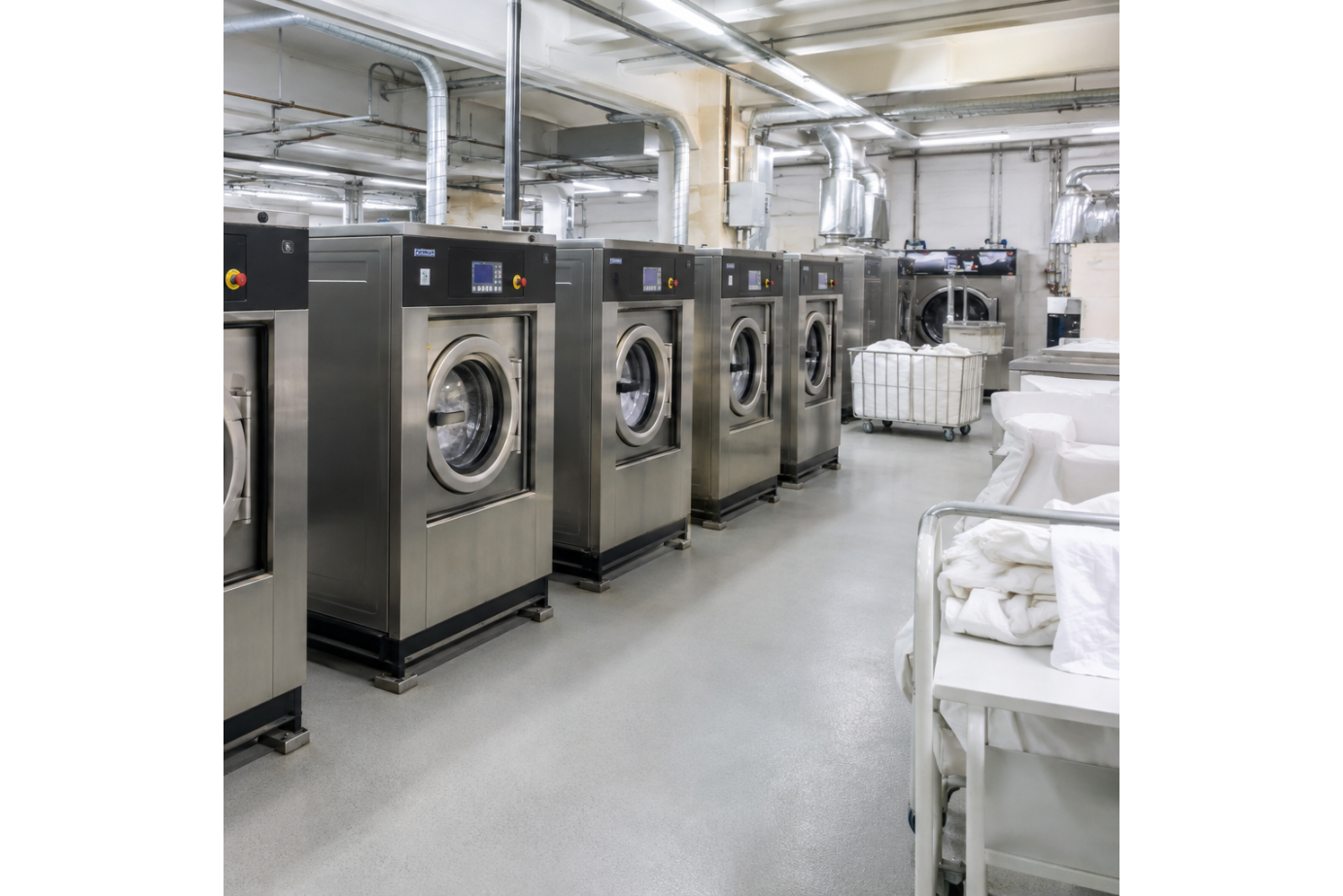
How to Calculate Washer Capacity for Your Business
To select washer capacity for a business, start with the kilograms of textiles produced each day, not with the largest model in a catalogue. Separate textiles by wash programme, allow for peak periods and estimate how many cycles fit into your working hours. This guide explains how to approach capacity sizing and avoid errors when comparing nominal loads.
How do you estimate daily laundry volume and peaks?
The right capacity depends on how much laundry you wash each day, how often you want to run the machine, and the available space. A washing machine that's too small forces multiple cycles, wastes time, and complicates organization; one that's too large can be inconvenient if you frequently use half loads. The best choice comes from a practical calculation: fabric type, average load weight, daily frequency, and seasonal peaks.
To get your bearings, consider these scenarios:
A professional solution for continuous washing
An industrial washing machine must help you maintain a stable workflow. This means being able to schedule washes in an orderly fashion, handle resistant or delicate fabrics, and reduce downtime between cycles. In a professional business, the difference lies not only in the kilogram capacity: it's also about the consistency of the results, the machine's robustness, and the ease with which staff can use it.
A good choice allows you to:
If you run a self-service laundry, it may be worth considering a coin-operated industrial washing machine , designed for self-service use by customers. In this case, in addition to capacity, ease of use, clear controls, durability for frequent use, and revenue management become important.
How can incorrect sizing increase running costs?
When it comes to industrial washing machine prices , the final price depends on several factors: capacity, configuration, product condition, accessories, delivery, installation, and service. Therefore, it's best to think about industrial washing machine prices as an overall investment, not simply as a quick comparison. A seemingly cheaper machine may become less cost-effective if it's not suited to the workload or requires frequent maintenance.
In the economic evaluation consider:
- Effective capacity : 15, 18 or 20 kg changes the daily productivity and the number of cycles required.
- Type of use : internal use, third-party laundry, self-service or accommodation facility have different needs.
- Product condition : A used industrial washing machine can be interesting, but it must be checked carefully.
- Assistance and spare parts : the availability of technical support is essential to avoid prolonged machine downtime.
- Consumption and detergents : water, energy and washing products affect the cost over time.
If you're looking for a used 20 kg industrial washing machine , always ask about its general condition, maintenance, electrical and plumbing compatibility, any warranties, and service options. The initial price is important, but in a professional environment, continuity of service is equally important.
Detergent, programs and final result
Industrial washing machine detergent is not a minor detail. A professional machine works best when detergent, temperature, cycle duration, and fabric type are all matched. Using unsuitable products can lead to residue, uneven results, or waste, especially with heavy and repeated loads.
To achieve a more controlled wash, consider:
A practical example: a restaurant with stained tablecloths has different needs than a gym that washes damp towels several times a day. In the former case, soil treatment and temperature are key; in the latter, rapid rotation, odors, and continuity of use are crucial. Therefore, a washing machine should be chosen with daily use in mind, not just the technical specifications.
Features to check before purchasing
Before confirming your purchase, gather essential information about your business. This step helps avoid choosing a machine that's too large, too small, or difficult to install. If you don't already have a dedicated laundry room, also check access, drainage, power supply, and space for loading and unloading laundry.
Useful checklist before the request:
With this information, comparisons become quicker and more concrete. Instead of just asking "how much does it cost?", you can identify which configuration really suits your needs.
Request a proposal suited to your washing volume
A reliable sizing exercise combines daily weight, cycle count, textile requirements and available installation space. Once demand is clear, compare the published capacities of real machines rather than presenting an approximate capacity as a product specification.
Once you have estimated the loads, complete the review with the commercial washer buying checklist. If the calculation points to relatively small batches, use the 10–15 kg industrial washer range as a comparison against the actual load profile.